24x7 Available All India Service Mohali Phase 7

Innova Crysta vs Tempo Traveller: Which One for a Family Trip

This is one of the first questions we ask when a family calls the Flywings desk to book a hill trip. Innova Crysta or Tempo Traveller. Both are among the most booked vehicles out of the tricity for outstation travel, and both are good vehicles, so the right answer is almost never about which one is better in general. It is about which one fits your specific group.

This guide walks through both vehicles properly, seats, luggage, comfort on hill roads, and actual cost, so that by the end you can make this call for your own trip without second guessing it.

The quick comparison

If you only have a minute, here is the whole comparison in one table.

Feature Innova Crysta Tempo Traveller
Seating capacity 7 seats (comfortably 6 with luggage) 12, 17 or 26 seater options
Luggage space Good for 4 to 5 large bags Large, fits luggage for the whole group plus extra
Best group size 4 to 6 people 8 people and above
One way rate Rs 18 per km Rs 24 per km
Round trip rate Rs 17 per km Rs 22 per km
Comfort on hill roads Excellent, built for hills Good, but a longer body feels the curves more
Best for Small families, couples with parents, hill routes Large families, groups, weddings, office outings

That table already answers the question for most people. If you are a group of 4 to 6, the Innova Crysta is almost always the right pick. If you are 8 or more, a Tempo Traveller works out both more comfortable and more affordable per person than booking two smaller cars. The rest of this guide explains why, with real numbers.

Getting to know the Innova Crysta

The Innova Crysta is the vehicle we recommend most often for hill routes out of Chandigarh and Mohali, and there is a clear reason for that. It has proper ground clearance, a stable ride on curved roads, and enough power to handle a steady climb without struggling. On a route like Chandigarh to Shimla or Mohali to Manali, this matters more than most people expect until they have actually done the drive.

Seating wise, the Innova Crysta is built as a 7 seater, but the honest, comfortable number for a multi day trip with luggage is 5 to 6 adults. The third row exists and works fine for shorter local trips or when the group includes children, but for a long hill drive with proper luggage, keeping the third row for bags rather than passengers makes the whole trip noticeably more comfortable.

Boot space is generous for the vehicle’s size. Four to five large suitcases fit without needing to stack bags on laps, which becomes important on a multi day circuit where everyone is carrying for more than one destination.

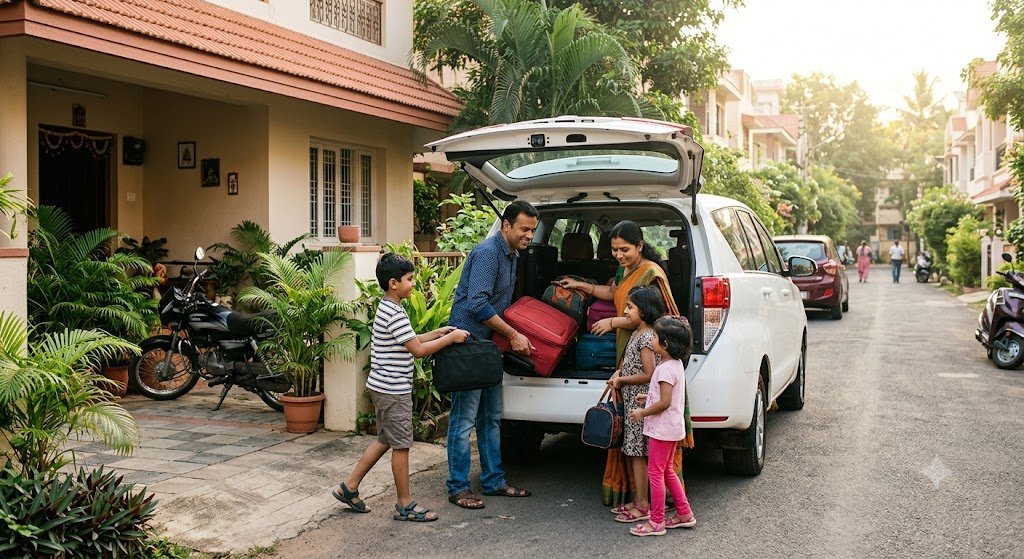
A family loading luggage into an Innova Crysta before an outstation trip

Who the Innova Crysta actually suits

  • A family of 4 to 6, including trips with elderly parents who need a comfortable, stable ride rather than a bouncy one
  • Couples or small groups doing a hill circuit with multiple stops, where the car needs to handle curves confidently
  • Anyone prioritising ride comfort and a smoother experience on winding roads over sheer group size
  • Airport and railway transfers for a family of up to 4, where comfort and a bit of extra room matter

Getting to know the Tempo Traveller

The Tempo Traveller is a different category of vehicle entirely. It comes in 12, 17 and 26 seater configurations, and it exists to solve a completely different problem than the Innova Crysta does. Where the Innova is about comfort for a small group, the Tempo Traveller is about keeping a large group together in one vehicle instead of splitting across two or three cars.

This matters more than it sounds. When a family or a group of friends splits across two cars for a trip, they almost always end up arriving at different times, stopping at different points, and losing the shared experience that was the whole point of travelling together. A single Tempo Traveller keeps everyone on the same schedule, the same stops, and the same conversation for the whole trip.

Luggage space on a Tempo Traveller is large enough that this stops being a planning concern entirely. Whether the group is carrying for a weekend or a full week, there is room for it, plus space for extra items like decoration material for a wedding trip or equipment for an office outing.

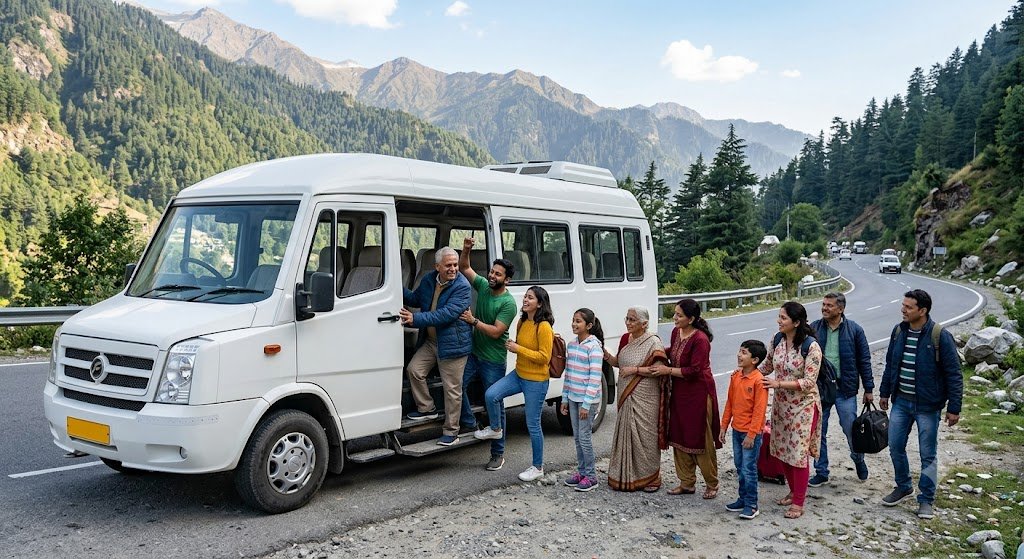
A large group boarding a Tempo Traveller for a hill trip

Who the Tempo Traveller actually suits

  • Extended families travelling together, especially for weddings, religious trips or reunions
  • Groups of friends or colleagues on a planned circuit, where staying together matters more than individual comfort per seat
  • Office outings and corporate offsites, where one vehicle and one driver is simpler to manage than several
  • Any group of 8 or more where booking two smaller cars would actually cost more overall

The cost comparison that actually matters

Per km rate alone does not tell the full story, because it ignores what happens when a group is too big for one Innova Crysta. Here is a real worked example for a Mohali to Manali round trip, 620 km total, for two different group sizes.

Group size Option Approximate cost Notes
5 people One Innova Crysta (Rs 17/km round trip) Around Rs 10,500 base fare Everyone travels together comfortably, one car, one driver
10 people Two Innova Crysta cars Around Rs 21,000 base fare Group is split across two cars, two drivers to coordinate
10 people One 12 seater Tempo Traveller (Rs 22/km round trip) Around Rs 13,600 base fare Whole group stays together, one driver, meaningfully cheaper than two Innovas

This is the exact calculation worth doing before any group booking above 6 or 7 people. Two Innova Crysta cars might feel like the natural next step up, but the numbers usually favour a single Tempo Traveller once the group crosses 8, both on cost and on keeping everyone together for the trip.

Why not just book a sedan or an SUV instead

This question comes up too, so it is worth answering directly. A sedan seats 4 and works fine for a small group on the plains, but it runs out of luggage space fast on a multi day hill trip and does not have the ground clearance that makes a real difference on a broken hill road. An SUV like an Ertiga or a Marazzo sits between a sedan and an Innova Crysta, seating 6, and is a reasonable middle choice for a slightly smaller budget, but for a family that wants the extra comfort and stability on hill curves, the Innova Crysta remains the stronger pick once the group crosses 4 people.

The reason we keep coming back to Innova Crysta and Tempo Traveller in this guide, rather than bringing every vehicle into the comparison, is that these two genuinely cover almost every family and group trip that comes through our booking desk. Between them, they handle a couple travelling with parents, a joint family of eight, and everything in between.

What our drivers tell us about these two vehicles

Talking to the drivers who actually run these routes week after week gives a more grounded picture than a spec sheet does. Drivers who mostly run the Innova Crysta on hill circuits consistently mention the same thing: passengers relax noticeably once the car starts climbing, because the ride stays flat and predictable through the curves instead of leaning hard on every turn. This is the single biggest reason we keep recommending it for small families with older parents on board.

Drivers who run Tempo Travellers regularly on group trips mention a different kind of comfort. Their feedback is less about the curves and more about the trip staying calm overall, because nobody in the group is texting someone in a second car asking where they are or when they will stop next. For a group travelling for a wedding, a reunion or an office trip, that single shared vehicle experience tends to matter more to the group than any small difference in ride quality.

A note on driving time and stops

One thing that surprises first time bookers is that a Tempo Traveller does not take meaningfully longer than an Innova Crysta on the same route, as long as the driver is experienced with the vehicle. The bigger factor in total trip time is almost always the number of stops a large group needs, not the vehicle itself. A group of 12 will naturally take slightly longer at a highway dhaba or a fuel stop than a family of 5, simply because more people means more time to get everyone back in the vehicle. Planning one extra stop into the day for a large group booking is a small adjustment that avoids the trip feeling rushed.

Comfort on hill routes: a fair comparison

The Innova Crysta has an edge here, and it is worth being honest about it rather than glossing over it. Its shorter wheelbase and lower centre of gravity handle continuous hairpin curves, like the stretch above Parwanoo toward Shimla, with less body roll than a longer vehicle. Passengers prone to motion sickness generally do better in an Innova Crysta on a route with heavy curves.

That said, a well driven Tempo Traveller handles hill routes perfectly well too. The difference shows up more on routes with continuous, tight switchbacks rather than on highway stretches or gentler climbs. For a route like Chandigarh to Dharamshala or Chandigarh to Dehradun, which mix highway driving with a shorter hill stretch at the end, a Tempo Traveller is completely comfortable for a large group. For a route that is almost entirely curves, like the final approach into Manali or the Kufri loop above Shimla, the Innova Crysta has a slight comfort edge, though this only really becomes relevant for the specific passengers most sensitive to motion.

What about a mixed group with elderly members?

This comes up often enough to deserve its own answer. If the group includes elderly parents or grandparents and the total group size is 6 or under, the Innova Crysta is almost always the better choice, since it offers easier entry and exit and a steadier ride. If the group is larger than 6 but still includes elderly members, a 12 seater Tempo Traveller with front row or second row seating reserved for them works well too, since the front rows sit closer to the axle and feel less of the vehicle’s length on curves than the rear rows do.

Either way, it is worth mentioning this to the operator at the time of booking. A good operator will seat elderly passengers accordingly rather than leaving it to chance once everyone is already in the vehicle.

A simple way to decide

Strip away everything else and the decision usually comes down to one number: how many people are actually travelling.

Your group size Recommended vehicle
1 to 3 people Sedan is enough, Innova Crysta only if you want extra comfort
4 to 6 people Innova Crysta
7 to 12 people 12 seater Tempo Traveller
13 to 17 people 17 seater Tempo Traveller
18 people and above 26 seater Tempo Traveller

If your group sits right on a border, say exactly 7 people, it is worth calling the desk rather than guessing, since the right call there depends on how much luggage you are carrying and whether the route is a heavy hill circuit or mostly highway.

How booking works either way

Both vehicles are booked the same way through Flywings, on a per km rate for one way or round trip, with the same fare structure of a base rate plus toll, parking and any night charge at actuals. Neither vehicle has a hidden premium attached to it beyond the per km rate shown, and both come with a police verified driver and a GST invoice at the end of the trip.

If you already know your group size and route, the fastest way to get an exact quote for either vehicle is a message on WhatsApp with your pickup city, drop city, travel dates and group size. We will tell you honestly which vehicle fits better for your specific trip, even if that means recommending the cheaper option.

Frequently asked questions

Can I fit 7 people comfortably in an Innova Crysta with luggage?
Technically yes, since it is a 7 seater, but for a multi day trip with proper luggage, 5 to 6 adults is the more comfortable number. For 7 or more with real luggage, a 12 seater Tempo Traveller usually works out both more comfortable and similarly priced.

Is a Tempo Traveller safe for hill routes?
Yes. Tempo Travellers run hill routes across Himachal and Uttarakhand every day and are completely safe with an experienced driver. The only real difference from an Innova Crysta is a slightly different feel on very tight, continuous curves, not a safety concern.

Does a Tempo Traveller have AC?
Yes, every Tempo Traveller we operate is AC. As with all our vehicles, AC usually runs on the plains and is switched off on hill routes, which is standard practice across the industry, not a way to cut a corner.

Can I book a smaller Tempo Traveller if I have exactly 8 or 9 people?
Yes, the 12 seater configuration works well for groups of 8 to 12, with room left over for luggage even at the higher end of that range.

Which one is better for a hill station wedding trip?
For a wedding trip where the extended family is travelling together, a Tempo Traveller is almost always the better call, since it keeps everyone on the same schedule and has enough room for decoration material, gifts and extra luggage that a wedding trip usually involves.

Do I need to book in advance for either vehicle?
For an Innova Crysta on a weekend, a day or two of notice is usually enough. Tempo Travellers, especially the 17 and 26 seater configurations, are fewer in number and get booked up faster during wedding season and peak summer months, so booking 4 to 5 days ahead for a large vehicle during those windows is a good habit.

Can children count as part of the seating limit?
Yes, a child old enough to occupy a seat counts toward the total. For very young children who will sit on a parent’s lap for most of the trip, mention this while booking, since it sometimes changes which vehicle makes sense for a borderline group size.

The bottom line

Neither vehicle is better than the other in any absolute sense. The Innova Crysta wins on comfort and hill road handling for a small group. The Tempo Traveller wins on keeping a large group together and on cost once you cross 7 or 8 travellers. Match the vehicle to your actual group size and the route you are taking, and either one will get you there comfortably.

Is Toll and Parking Included in Your Outstation Cab Price

If you have ever booked an outstation cab and then got a bill that did not match the number you had in your head, you are not alone. It is one of the most common complaints we hear on the phone at the Flywings booking desk in Mohali, and almost every time, the confusion comes down to one thing. The person booking the cab thought the per km rate they were quoted was the final price. It never is, and it is not supposed to be, but nobody explained that clearly before the trip started.

This guide is going to walk through exactly what an outstation cab fare covers, what it never covers, and why toll and parking are treated the way they are across the entire industry, not just by us. By the end you will know exactly what to expect on your final bill before you even step into the car.

The short answer

No. Toll tax and parking charges are not included in the per km rate you are quoted for an outstation taxi. This is true almost everywhere in India, whether you book through a local operator, a big aggregator app, or a travel agent. The per km rate covers the car, the fuel and the driver. Toll and parking are billed on top, at the actual amount paid on the road, usually shown to you with the receipt.

That is the one line answer. But if you stop reading here, you will still get surprised on your next trip, because the real question is not whether toll is included. It is how much it usually adds up to, and how to plan for it so nothing on the final bill feels like a shock.

Why the per km rate does not include toll and parking

Think about what a per km rate is actually built to cover. It is a rate for using the vehicle and the driver’s time and skill, over a certain distance. Fuel is tied to distance too, so it fits naturally into that per km number. A car that does 15 km per litre will burn roughly the same fuel whether you are on NH44 near Ambala or the Kalka climb toward Shimla, so fuel can be averaged into a flat per km figure without much error.

Toll and parking do not behave like that. A route with three toll plazas costs the operator a fixed rupee amount no matter which car goes through, and that amount has nothing to do with distance. Chandigarh to Delhi and Chandigarh to Katra are both long routes, but they do not cross the same number of toll booths, and the toll rates on each highway are set by the National Highways Authority of India, not by any taxi company. If an operator tried to average toll into a flat per km rate, one of two things would happen. Either the rate would be too high for short routes with no toll roads, or too low for long national highway routes with several toll plazas, and either way you would be paying for a number that does not match your actual trip.

Billing toll and parking separately, at the actual amount, keeps the per km rate honest. You pay for the road exactly what the road costs, no more and no less, and the receipt from the toll booth backs up the number on your final bill.

What is actually included in the per km rate

Before getting into what gets billed on top, it helps to be clear about what the base rate already covers. This is the part that should never change once you have a confirmed booking.

Included in the per km rate What this means for you
Base per km fare The exact rate agreed for your car type, for the full distance travelled
Fuel charges Petrol, diesel or CNG, whichever the car runs on, fully covered
Driver charges The driver’s base fee for the trip is already built into the fare
AC running Included in the plains. On hill routes the AC is usually kept off, which is standard practice and not a way to cut a corner
Vehicle upkeep Servicing, tyres and general maintenance are the operator’s cost, not yours
GST invoice A proper bill you can use for expense claims or company reimbursement

If a driver ever asks you for extra money for fuel mid trip, something is wrong, because fuel is already paid for inside the fare you agreed to. That one is never a legitimate on road charge.

What gets billed separately, and why each one exists

Now for the part that actually causes confusion. These charges are real, they are normal across the whole industry, and a good operator will tell you about every single one of them before you travel, not after.

Charge How it is billed
Toll tax At actual cost, shown with the toll receipt from each plaza
State tax and permit Applies only when the car crosses into another state’s territory
Parking charges At the actual amount paid at the parking lot or hotel
Night charge Applies between 10 PM and 6 AM, since driving at night carries a higher cost for the operator
Driver night allowance A fixed per day allowance on trips longer than 300 km in a single day, since the driver is away from base overnight
Hill and off road charge A small extra applies on genuine hill routes, since these roads put more wear on the vehicle
Waiting charges The first 30 minutes at any stop are free, after that a small hourly charge applies
Extra sightseeing km Any detour off the originally planned route is billed for the extra distance covered
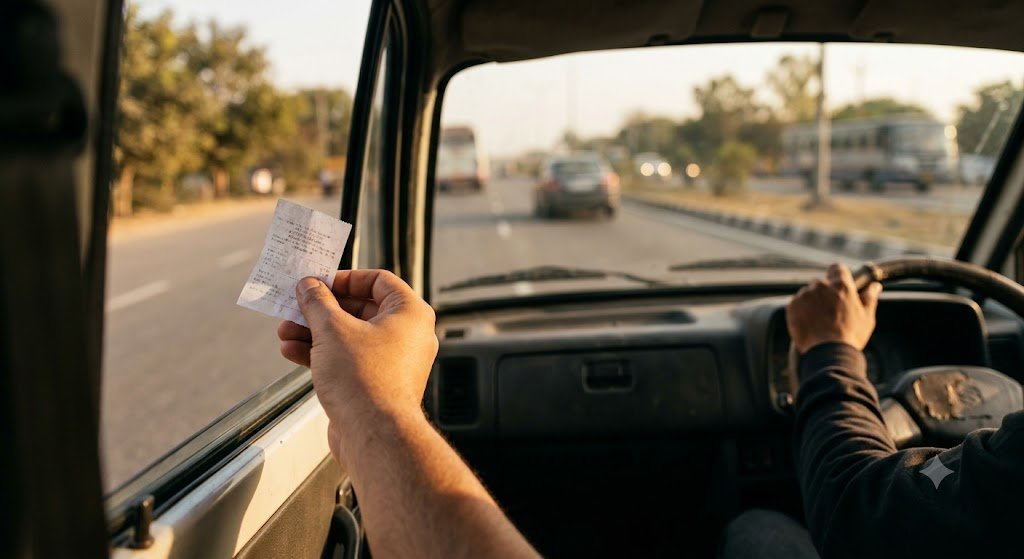
Toll receipt handed over at a highway toll plaza during an outstation cab trip

None of these are hidden fees in the bad sense of that phrase. They are standard, predictable costs that any honest operator will walk you through at the time of booking. The problem only shows up when an operator stays quiet about them until the trip is already over, which is exactly the moment a customer has the least room to negotiate.

A real example: Chandigarh to Manali, round trip

Numbers explain this better than any list of rules. Here is roughly how a round trip from Mohali to Manali breaks down for a family booking an Innova Crysta, using our published starting rate of Rs 17 per km for a round trip.

Cost head Approximate amount Notes
Distance 310 km one side, 620 km both ways Mohali to Manali via Kiratpur Sahib and Mandi
Base fare (Rs 17/km x 620 km) Rs 10,540 This is the number quoted upfront
Toll tax (both ways) Rs 600 to 800 Two to three toll plazas on the route, exact amount from receipts
Parking (per day in Manali) Rs 100 to 200 per day Depends on the hotel or market parking used
Driver night allowance Rs 300 to 400 per day away from base Applies since Manali is an overnight, multi day trip

So a trip quoted at roughly Rs 10,500 for the driving itself usually lands somewhere around Rs 12,000 to 13,000 once toll, parking and the driver allowance for the days away are added in. That gap is not the operator changing the rules midway. It is the actual, receipted cost of the road and the days involved, and any operator worth booking with will tell you this range before you leave Mohali, not after you return.

A shorter example: Chandigarh to Delhi, one way

A same day, one way drop looks much simpler, because there is no overnight stay and usually only one or two toll plazas involved.

Cost head Approximate amount
Distance 245 km, Chandigarh to Delhi via NH44
Base fare, sedan, one way (Rs 11/km) Rs 2,695
Toll tax Rs 300 to 400
Parking Usually nil for a straight drop, unless you ask for a stop

On a route like this, toll is a small enough add on that most customers barely notice it. The confusion tends to happen on the longer, multi day hill trips where toll, parking and the driver allowance together can add a meaningful amount to the base fare, which is exactly why we always walk a customer through this before confirming a hill route booking.

How toll tax actually works on Indian highways

It helps to understand where this money is even going, because it is not going to the taxi operator. Toll tax on Indian national highways is collected by the National Highways Authority of India, or by private companies that built and maintain a specific stretch under contract. The amount depends purely on the stretch of highway and the category of vehicle, not on who is driving or why. A car pays the car rate whether it is a private vehicle, a taxi, or a rental car.

Most toll plazas today run on FASTag, an electronic tag stuck to the windscreen that deducts the toll automatically as the car passes through, without stopping. This has actually made toll tracking easier for both operators and customers, because every FASTag deduction shows up as a clean, timestamped entry, which means the toll amount on your final bill can be verified against the actual deductions rather than taken on trust.

How parking charges work

Parking is more variable than toll, because it depends entirely on where the car ends up parking, not on any fixed highway rate. A car parked on a quiet residential street costs nothing. A car parked in a paid lot near Mall Road in Shimla, or in the crowded market area near the Vaishno Devi base camp in Katra, will have a real per hour or per day charge attached to it.

Most hotels in hill stations either include parking for guests staying overnight or charge a small flat fee for it, and this is usually the biggest parking cost on a multi day trip rather than the day to day sightseeing stops. If you are booking a hotel yourself rather than through the operator, it is worth asking the hotel directly whether parking is included, since that number then never has to touch your cab bill at all.

Why night charges and driver allowance exist

These two often get bundled into the same confusion as toll and parking, so it is worth separating them clearly. A night charge applies specifically to driving between 10 PM and 6 AM, because driving at night is more demanding on a driver and carries a real cost for the operator in terms of driver availability. A driver night allowance is different. It is a fixed per day amount paid when a driver has to stay away from their home base overnight, which happens automatically on any multi day outstation trip.

Neither of these is something an operator invents to pad a bill. They reflect a real cost that exists whether you book with us or with anyone else, and a written quote that mentions both upfront is a sign of an operator being straightforward with you rather than trying to win your booking with an artificially low headline number.

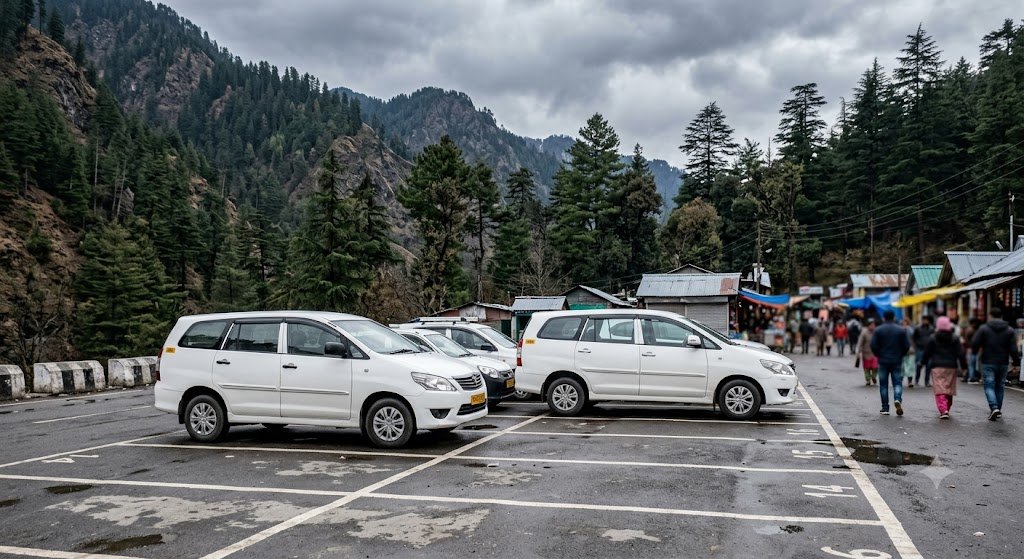
Taxis parked in a paid parking area near a hill station market

How to avoid any surprise on your final bill

The good news is that all of this is entirely predictable, and a few simple habits will make sure your final bill matches what you expected almost to the rupee.

  • Ask for a full written quote, not just a per km rate. A proper quote breaks out the base fare, the expected toll range, and any night charge or driver allowance that applies to your specific dates and route.
  • Ask about the route in advance. The number of toll plazas and the total toll amount depends on the exact highway taken, so a route via NH44 and a route via a state highway can have a different toll total even over a similar distance.
  • Keep every toll and parking receipt. A driver working with an honest operator will hand these over without being asked, and they are the proof behind every rupee billed on top of the base fare.
  • Confirm hotel parking before the trip. A quick call to your hotel about parking can remove one more variable from the final bill entirely.
  • Compare the total trip cost, not just the per km number. A slightly higher per km rate from an operator who is upfront about toll and parking is almost always a better deal than a lower headline rate from one who is not.

How this works with Flywings

At the Flywings booking desk, every quote sent over a phone call or WhatsApp includes the base fare, the expected toll range for that specific route, and whether a driver night allowance applies. We do this because we would rather a customer know the real number before they leave home than find out on the road. Toll and parking are always billed at the actual receipted amount, never rounded up, and every trip closes with a GST invoice that itemises the base fare separately from the on road charges.

If you already have a route in mind and want the exact toll estimate along with the base fare, the fastest way to get it is a message on WhatsApp with your pickup city, drop city, travel date and preferred car. We usually reply with a full written quote within a few minutes.

Frequently asked questions

Is toll tax the same every time I travel the same route?
Mostly yes. Toll rates on a given highway stretch are revised periodically by the highway authority, usually once a year, so the amount can shift slightly between trips even on the exact same route. It does not change based on who is driving or which operator you book with.

Do I pay toll in cash or is it automatic?
Almost every toll plaza on major highways in India now runs on FASTag, so the toll is deducted automatically as the car passes through. You do not need to carry cash for this, and the amount shows up clearly on the trip receipt.

Why did my quote not mention parking at all?
For a same day, one way drop with no planned stop, there is usually no parking charge at all, which is why some quotes leave it out entirely. It only becomes a real cost on multi day trips where the car is parked overnight.

Can I ask the operator to include toll and parking in a single flat price?
Some operators will offer this for very well known, fixed routes, but the flat price will always be set high enough to cover the worst case toll and parking scenario, which usually means you end up paying more than the actual cost. Paying at actuals, with a receipt, is almost always the fairer option for the customer.

What if the toll amount on my bill looks too high?
Ask for the toll receipts. A genuine operator will have one for every plaza the car passed through, and the total on your bill should match the sum of those receipts exactly.

The one thing to remember

Toll and parking are not hidden charges. They are real, receipted, on road costs that exist on every outstation trip in India, no matter who you book with. The only real question worth asking before you travel is whether your operator will tell you about them upfront, in writing, before you get in the car. That single habit, asking for the full picture before you book, is what turns a confusing bill into a completely predictable one.

Call WhatsApp Book Now