Anyone booking a long outstation drive for the first time has a version of the same question, what actually happens during the hours on the road, does the driver stop, how often, and does stopping for tea or a meal add to what you end up paying. These are reasonable things to want clarity on before a seven or eight hour drive, and the honest answer involves real practice and real rules, not just a reassuring line about the driver knowing best.
It is also a fair question to ask precisely because most outstation bookings happen over a phone call or a message, not a long sit down conversation where every detail of the trip gets discussed in advance. Knowing the realistic pattern ahead of time, roughly how many stops, roughly how long each one takes, and how the cost works, means you can plan your own day around the trip with a reasonably accurate picture, rather than guessing.
The short answer
Yes, drivers stop regularly on a long outstation drive, for safety as much as anything else, and these stops do not add to your fare since every trip is billed per kilometre, not per hour. A typical stop is a short tea or meal break at a highway dhaba, the roadside restaurants that line every major Indian highway, and on longer routes there is usually more than one.
Why breaks happen, the real rule behind it
Commercial drivers in India fall under rules, most directly the Motor Transport Workers Act, 1961, that are meant to prevent exactly the kind of fatigue that causes accidents on long highway drives. The commonly cited standard is a rest interval after five hours of continuous driving and a cap on total driving hours in a single day. Enforcement of these rules across the commercial passenger vehicle sector is acknowledged to be inconsistent, reporting on driver fatigue in India has pointed out that there is no single comprehensive framework covering every category of commercial driver, but the underlying safety logic is sound regardless of how strictly any one state enforces it, a driver who has been behind the wheel for hours straight is not driving as safely as one who stopped, stretched, ate something and is alert again.
Our own drivers are not exempt from ordinary human fatigue, and we would rather a driver take a break than push through tiredness to save fifteen minutes, which is the honest reason breaks happen on our trips, not a scripted policy line.
It is worth being direct about the gap between the rule as written and how consistently it is enforced across the industry as a whole. Reporting on commercial driver fatigue in India has pointed out that enforcement is uneven and that dedicated fatigue monitoring technology for heavy vehicles is not scheduled to become mandatory until 2028. We mention this not to claim a certification we do not hold, but because it is more honest to say plainly that the safety standard exists and we follow its spirit, rather than imply a level of formal regulatory oversight that the industry does not yet uniformly have.
What a typical stop actually looks like
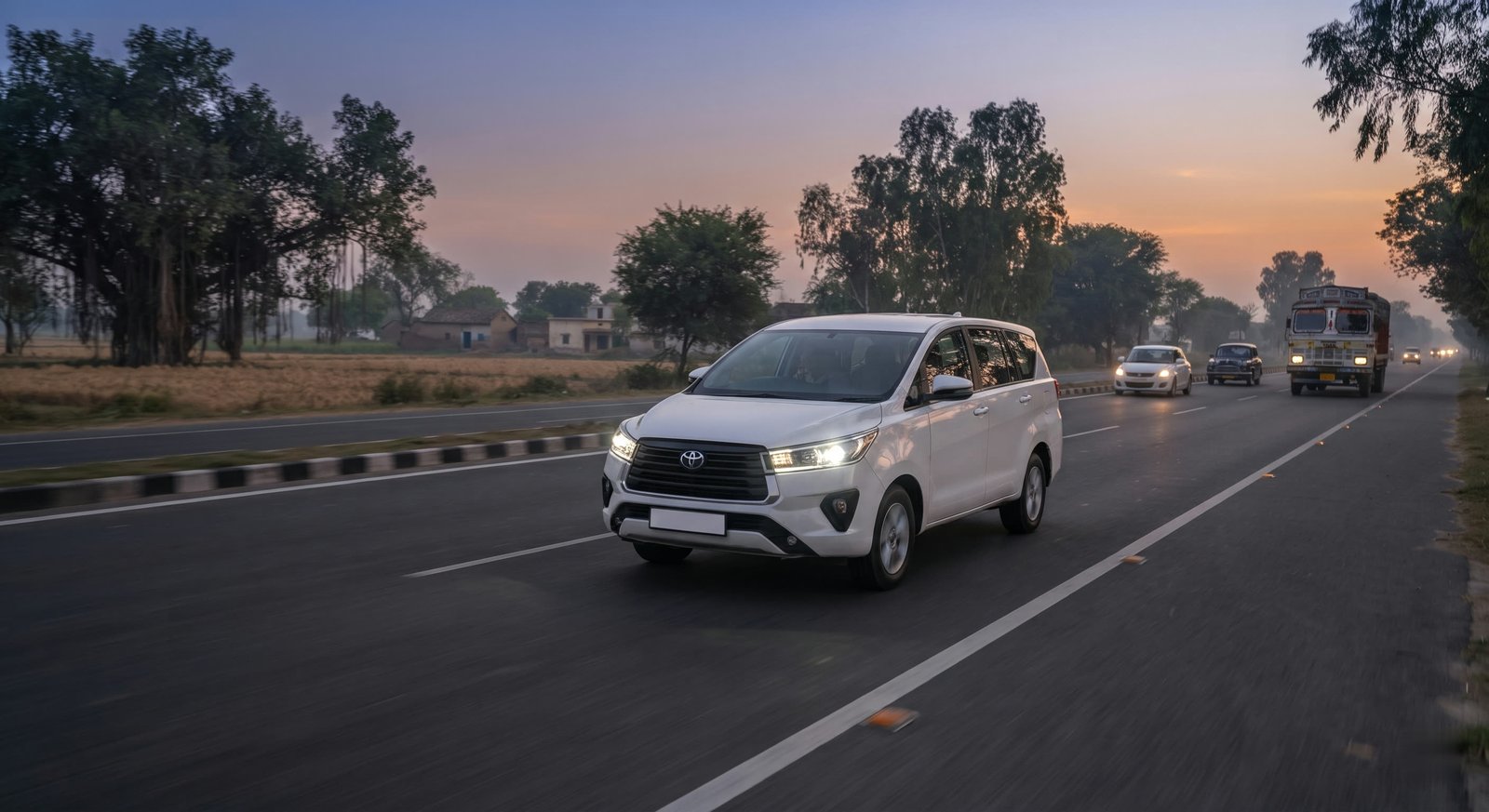
India’s highway dhaba culture is genuinely old and genuinely functional, not a modern addition for tourists. The culture grew out of stops built originally for truckers on routes like the Grand Trunk Road, and towns like Murthal in Haryana, sitting directly on the Chandigarh to Delhi route, became known specifically because of this, a dhaba that started as a modest stop for truck drivers decades ago and is now a well known halt for every kind of traveller passing through on NH1. If you are driving Chandigarh to Delhi with us, a stop in that stretch is a realistic, well worn part of the route, not an unusual detour.
A typical dhaba stop is simple and quick, tea, a plate of dal and roti, sometimes a tandoor dish, rarely a long sit down meal unless the group specifically wants one. Most dhabas on major highways operate long hours, many effectively around the clock, so a stop is rarely a question of finding somewhere open, it is more a question of timing it sensibly around your own schedule, an early departure, a flight to catch, or simply wanting to reach the destination before dark.
How many stops to actually expect, by route length
There is no single fixed number, it depends on the route, the time of day, and the group’s own preference, but here is a realistic sense of it based on our actual route distances and drive times.
Two to three stops, and worth discussing an overnight break
Each stop typically adds thirty to forty five minutes to the overall trip, which is why the drive times quoted on our route pages are road time only and do not build in stops, worth factoring in yourself when planning around a flight or an event at the other end.
Stops do not change your fare, here is why
Every trip type we run, one way or round trip, is billed on distance, the per km rate for your car type multiplied by the kilometres actually covered, not on time spent on the road. A driver stopping for a meal, waiting out a short traffic jam, or taking a safety break does not add anything to the kilometre count, so none of it shows up in your final fare. This is worth knowing upfront because it means there is no reason to feel rushed into skipping a break the driver genuinely needs, a twenty minute stop costs you twenty minutes, not an extra line item on the bill.
Longer drives and the driver night allowance
On routes where the car covers more than 300 km in a single day, a separate driver night allowance applies, covered in full in our driver night allowance post. This is a distinct charge from the stops discussed here, it exists because the driver is covering a genuinely long distance in one day, not because of how many tea breaks were taken along the way. On a round trip lasting several days, the driver also arranges his own overnight stay at the destination between the outbound and return legs, which is standard practice on every multi day booking and is not billed to you as a separate charge.
Hill routes change the break pattern more than flat routes do
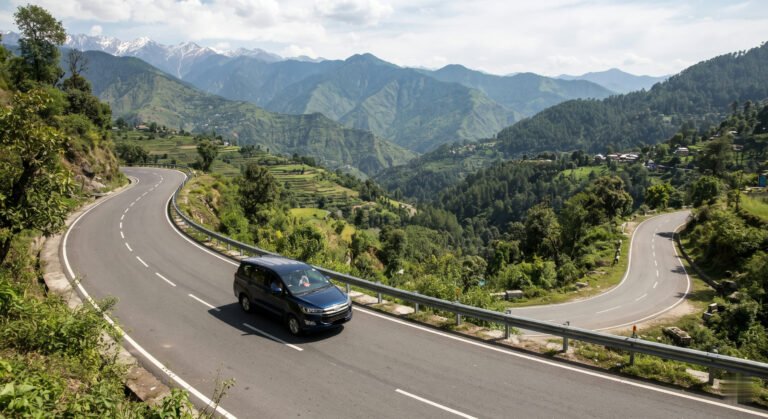
A flat highway drive like Chandigarh to Delhi is mostly steady speed with clear sightlines, which is a very different kind of fatigue than hours of continuous turns on a hill route like Manali or Dharamshala. Winding roads demand constant attention in a way a straight highway does not, which is part of why the realistic stop pattern on our hill routes tends to be spaced a little closer together than the drive time alone would suggest, a short break every couple of hours on a long climb rather than one single stop at the halfway point.
Hill routes also carry their own additional considerations once it gets dark, reduced visibility on roads with sharper turns, and in some stretches a higher chance of encountering roadside animals or slower moving local traffic. This is one reason a driver on a hill route may plan the day’s driving to avoid finishing the climb well after dark where the route allows it, timing that is worth discussing when you book if your schedule has some flexibility on departure time.
What to expect for yourself during a stop
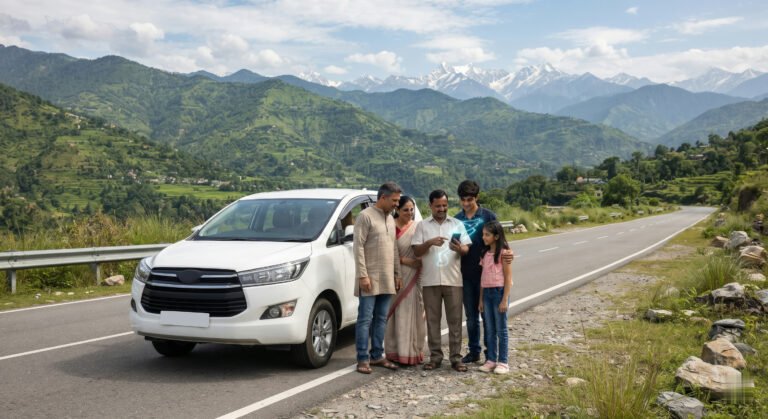
A dhaba stop is also a reasonable moment to stretch, use a washroom, and let kids or elderly passengers move around briefly, not just a break for the driver. Most well established stops along our main routes have reasonably clean facilities, though standards do vary stop to stop the way they would along any highway anywhere. If anyone in your group has specific needs, a particular diet, a preference for a sit down meal rather than a quick tea stop, or simply wanting a longer break than usual, mentioning it to the driver at the start of the trip means the stop can be planned around it rather than improvised midway.
Can passengers ask for an extra stop, or skip one?
Yes to both, within reason. If your group wants a longer stop to see something along the route, or a specific restaurant rather than the first dhaba that comes up, telling the driver directly works, the itinerary is not rigidly fixed once you are on the road. Equally, if your group is in a genuine hurry, for a flight or an event, say so early in the drive rather than at the last stretch, a driver who knows your timing constraint from the start can plan the one necessary safety break more efficiently than one who only learns about the deadline when it is already tight.
What is not negotiable, and should not be, is skipping the driver’s own rest entirely on a long route to save time. A tired driver is a real safety risk for everyone in the car, and the honest position we take is that a short, sensible break is worth far more than the fifteen or twenty minutes it costs.
Planning stops around your own trip, not just the driver’s
A break is also a practical planning point for you, not only a safety measure for the driver. If you are travelling with young children or elderly family members, knowing roughly where the first stop will fall lets you plan around nap times or medication schedules rather than hoping it works out. If the group has a strong food preference, vegetarian only, or avoiding a specific cuisine, saying so when you book means the driver can choose a stop that actually works for everyone rather than defaulting to whichever dhaba comes up first on the route.
For early morning departures, especially on routes like Delhi or Jaipur where leaving before sunrise is common to avoid daytime heat or traffic, the first stop often ends up being more about breakfast and a proper cup of tea than anything else, which is worth keeping in mind if your group has a particular routine around a morning meal.
How this works with Flywings
Every driver on our network is expected to take the breaks a long route genuinely calls for, and this is built into how routes and timing are discussed with you at the time of booking, not something you discover for the first time on the road. If you have a hard deadline at the other end, a flight, a wedding, a meeting, tell us when you book, and we will factor realistic stop timing into the plan rather than leaving it to chance. Message us on WhatsApp with your route and your actual schedule and we will give you a realistic total trip time, breaks included.
Frequently asked questions
Do I pay extra if the driver takes a longer break than usual?
No, fare is based on distance covered, not time elapsed, so the length of any stop along the way does not change what you are billed.
Is there a fixed number of stops required by law on a route like Chandigarh to Manali?
There is no single rigid rule that is strictly enforced across the commercial passenger vehicle sector in India, but the underlying safety standard calls for a rest break after several hours of continuous driving, which our drivers follow as standard practice on longer routes.
Can I request the driver skip stops to reach faster?
You can ask the driver to minimise unnecessary stops, but a genuine safety break on a long route should not be skipped entirely, it protects everyone in the vehicle, including you.
Are dhabas on the highway hygienic and safe for a family to eat at?
Standards vary by establishment the same way restaurants anywhere do, well known stops along major routes, including the ones near Murthal on the Delhi route, see heavy daily traffic from all kinds of travellers and are a normal, common choice, not an unusual risk.
Does a short route like Chandigarh to Shimla need a stop at all?
Not always, at just over three hours it is often driven without a formal stop, though a short tea break is common if the group wants one.
What happens if we are running late for a flight and do not want any stops?
Tell the driver and our booking desk about the deadline as early as possible, a short, necessary safety break can usually still be worked in efficiently even on a tight schedule, rather than being skipped altogether.
Is the driver’s meal break the same time as ours, or separate?
Usually the same stop works for everyone, the driver typically eats during the same halt rather than taking a separate break later, which keeps the overall trip time shorter.
Do overnight multi day trips involve the driver stopping to rest at a hotel like we do?
Yes, on a multi day round trip the driver arranges his own stay at the destination between legs, the same basic need for rest that applies to the breaks during the drive itself.
Do hill routes need more stops than flat routes of a similar drive time?
Often yes, the constant attention winding roads demand tends to call for breaks spaced a little closer together than a flat highway drive of the same length, even when the total time is similar.
Should we avoid starting a hill route trip too late in the day?
It is sensible to plan an early start on a long hill route where possible, so the drive is not pushed into darkness on winding roads, worth discussing with us when you book if your schedule allows flexibility on departure time.
The one thing to remember
Breaks on a long outstation drive are a safety practice, not a billable extra, your fare is set by distance, not by how long the drive actually takes including stops. Expect one or two realistic stops on most of our longer routes, tell us upfront if you are working around a tight deadline or a specific food preference, and trust that a driver who takes a short break is driving you more safely for the rest of the trip, not less efficiently. A few minutes at a highway dhaba is a small, ordinary part of almost every long Indian road trip, not a delay to be anxious about.