24x7 Available All India Service Mohali Phase 7

Chandigarh to Jaipur by Road: Is a One Day Drive Comfortable, or Should You Break the Journey?

Jaipur is one of the longest regular routes we run from the tricity, and the question comes up on almost every booking call: can we just do it in one day, or should we break the journey? The honest answer depends on your group, your pace and what you actually want out of the trip, and a lot of people who try to push through a single day regret it by the time they reach the Pink City. This is the full picture, with the real distances behind it.

The short answer

Chandigarh to Jaipur covers 520 km and takes around 9 hours of driving in normal conditions. It is doable in one day if you leave very early and keep stops short, but it is a long, tiring day for anyone who is not a confident long distance traveller. For most families, couples travelling with elderly parents, or anyone with a full day of sightseeing planned in Jaipur, breaking the journey into two days is the more comfortable choice. The break point that works best is roughly the Delhi region, since the first leg of the route runs close to Delhi.

The distance, broken into its natural stages

It helps to see the route in pieces rather than as one long number, since the stages are what make the decision clear.

Stage Distance What it means for the day
Chandigarh to Delhi region About 245 km Roughly the first half of the drive, the natural place to pause if you break the trip
Delhi region to Jaipur About 275 km The second half, a full driving session on its own
Full route, Chandigarh to Jaipur 520 km, about 9 hours of driving Realistic door to door once stops are added, around 10 to 11 hours

Looking at the stages this way, the first leg to the Delhi region is comfortable as a morning drive, and the second leg is what makes a same day arrival tiring, since the afternoon drive into Rajasthan runs right into the heat and the day’s fatigue.

Why a one day drive is harder than the number suggests

A 520 km drive on paper looks like a long but manageable day, the same as a comfortable motorway trip. In practice it is more demanding for several reasons. Hours of continuous driving add up, and driver fatigue is a real safety consideration on any long single day, which is why we plan the driver’s working hours carefully on a route like this. Lunch, fuel and comfort stops take real time, and on a 520 km route that adds up to an hour or more. And the arrival in Jaipur is later than most people expect, which leaves less of the evening for the Pink City itself. None of this makes the trip impossible, it just means the honest timing is more like ten or eleven hours than nine.

What breaking the journey actually looks like

Splitting the trip into two days is simpler than it sounds. The first day covers the drive from Chandigarh or Mohali to the Delhi region, and the second covers the rest of the route into Jaipur. The overnight stop is usually on the Delhi side of the route, which gives you good hotel options and a comfortable first evening, and the second day starts early enough to reach Jaipur in time for an afternoon at the city. This is generally the recommendation for families and anyone with a full sightseeing plan in Jaipur.

It also means the driver stays away from base overnight, which is the same driver night allowance logic that applies to any multi day outstation trip. This is covered clearly in the quote, so you know the cost of the overnight stop upfront rather than discovering it later.
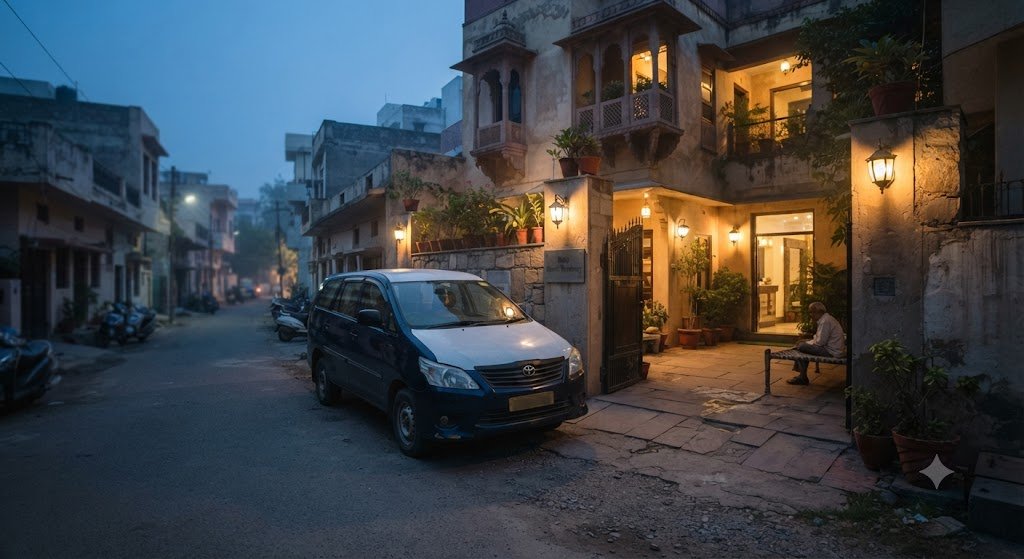
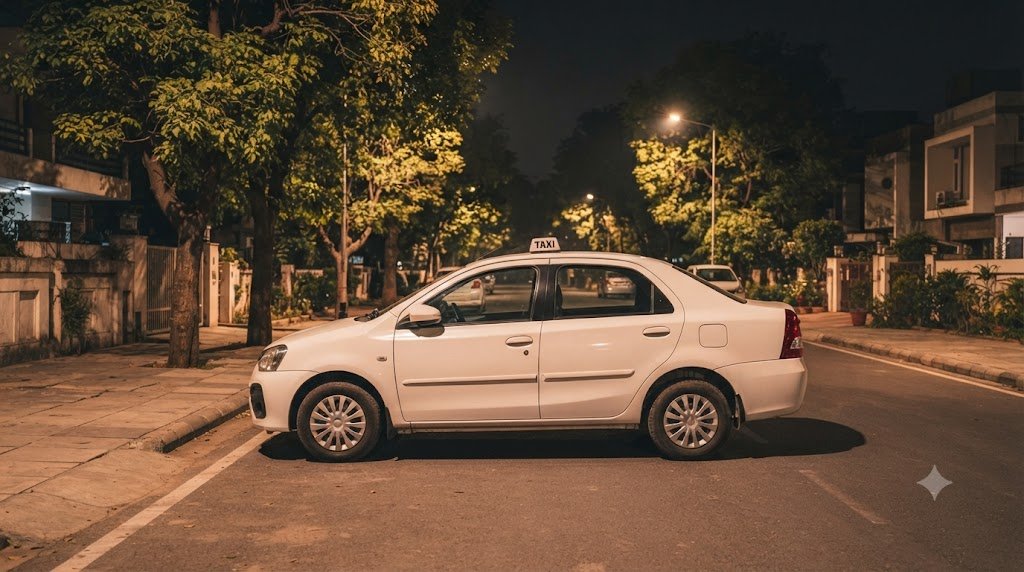
Taxi parked outside a small hotel courtyard on the edge of Delhi at dusk

When a one day drive still makes sense

Breaking the journey is not always the right answer. A one day drive works well for a small, experienced group travelling light, with no fixed sightseeing commitments on the day of arrival, who are comfortable with long highway hours and would rather arrive in Jaipur in the evening and start fresh the next morning. It also suits travellers who only need to reach Jaipur as a single stop before moving on to a longer Rajasthan circuit, where the hotel is already waiting and the arrival time matters more than the comfort of the drive.

If you choose the one day option, the key is an early start. Leaving Chandigarh or Mohali before first light keeps the first half of the drive in cooler, clearer conditions and gets you past Delhi before the worst of the city traffic builds.

Which car suits a long Jaipur drive

A route this long rewards a comfortable, higher seated vehicle more than a short trip would. An Innova Crysta or SUV is more comfortable over a long single day drive than a hatchback or sedan, with more legroom, better suspension for the long stretches and room for luggage on a multi day trip. For a family of four with normal luggage, a sedan works, but for a family of five or more or anyone sensitive to long hours in a car, the step up to an SUV or Innova Crysta makes the drive noticeably easier.

Car type Seats and luggage How it suits a long Jaipur drive
Sedan 4 seats, 3 bags Works for a small family with normal luggage, less room for long hours
SUV 6 seats, 4 bags Comfortable choice for a family of five or six, more legroom over long stretches
Innova Crysta 7 seats, 4 bags Most comfortable for a long single day or a multi day trip with full luggage

Round trip or one way for Jaipur

Most of our Jaipur bookings are round trips, often as part of a longer Rajasthan circuit, since the car is needed for the return leg and onward sightseeing. If you are only heading to Jaipur and flying back out, a one way booking makes more sense, and the one way rate is the right one to compare against. The choice is covered in detail in our one way versus round trip cost comparison, and for the full rate table see our one way taxi service page.

Jaipur as the start of a longer Rajasthan circuit

For many travellers Jaipur is not the final stop but the first of several, and the drive from the tricity is the start of a wider Rajasthan trip. Our Rajasthan Heritage package covers Jaipur, Jodhpur, Udaipur and Jaisalmer over eight days with one car throughout, and the Golden Triangle covers Delhi, Agra and Jaipur over six days. If your trip is heading onward to Jodhpur or further, the single car and driver for the whole circuit removes the need to rebook at each city, and the quote covers the full itinerary as one trip. Telling us the onward plan early lets us structure the route and the number of driver nights correctly from the start.

Planning your first day in Jaipur

Arriving late in the afternoon after a long drive leaves little time for the forts, so plan the first evening lightly. Check into your hotel, have a proper meal and rest, and keep the big sightseeing for the next morning when you are fresh. Amber Fort is best done early, before the buses arrive, and it makes a good first morning. From there the car can take you back into the city for the Hawa Mahal and City Palace, with lunch in the old city and an afternoon at Jantar Mantar. This ordering keeps the day manageable and avoids the common mistake of trying to see everything on a single exhausted arrival evening.

What to see in Jaipur once you arrive

Jaipur rewards a proper afternoon and a full second day, and the sights are spread across the city, so the car is genuinely useful for getting between them.

  • Amber Fort, a short drive out of the city, best reached in the morning before the crowds build
  • Hawa Mahal, the Palace of Winds, a quick stop in the old city
  • City Palace, a full visit with its museums and courtyards
  • Jantar Mantar, the old astronomical observatory, a short visit with a lot to see
  • Nahargarh Fort, a good spot for sunset views over the city

Plan the day around the timing of the forts, since the best light and the fewest crowds are early in the morning, and Nahargarh works well as an evening stop once the heat of the day has eased.

Planning the drive for a stress free arrival

Whether you break the journey or not, a few habits make the drive much easier. Eat a proper breakfast before setting out rather than relying on roadside food in the first hour. Plan one fuel and rest stop around the midpoint instead of several short ones, since frequent stops on a long route cost more time than they save. And keep a copy of your booking and the driver’s contact details handy, since a long route means more chances for a last minute change of plan that needs quick coordination.

The return leg from Jaipur, and why it deserves its own plan

Whichever way you travel out, the return is the part most likely to be underestimated. A round trip to Jaipur covers the same 520 km back, and the drive home after several days of sightseeing is tiring in a different way from the outbound leg. Plan the return for a morning departure from Jaipur, reach the Delhi region in daylight, and consider the same split as the outbound trip if you want a gentler finish. If you are continuing from Jaipur to another city instead of returning to Chandigarh, tell us that at the start, since the return leg then becomes part of a longer onward route rather than a simple drive home.

What to pack for a Jaipur trip

Jaipur is hot for much of the year, and the drive itself exposes you to a lot of sun through the plains. Light cotton clothing, a hat or cap, sunscreen and plenty of drinking water are essential, especially between March and June. Comfortable shoes matter more than people expect, since the forts involve a lot of walking and steps. A light jacket is worth carrying in winter, when mornings in Rajasthan can be cool. And if you are travelling with children or older passengers, carrying their regular medication in a slightly larger supply is sensible for a trip where the drive itself is the longest part.

How this works with Flywings

We run the Chandigarh and Mohali to Jaipur route regularly, as one way, round trip and multi day Rajasthan circuits. Tell us whether you want to do the drive in one day or break it, your group size and bag count, and your sightseeing plan, and we will quote the trip with the overnight stop shown as its own line if you choose to split it. See our Chandigarh to Jaipur taxi page for the route details, or our Jaipur taxi service page for local coverage and sightseeing.

If you are planning a Jaipur trip and want an honest recommendation on whether to break the journey, message us on WhatsApp with your dates and group details and we will tell you straight, including which overnight stop suits your timing best.

Frequently asked questions

How long does the drive from Chandigarh to Jaipur take?
Around 9 hours of driving over 520 km, realistically 10 to 11 hours with stops, which is why many people split the journey.

Is it possible to do the whole drive in one day?
Yes, with a very early start, but it is a long and tiring day, particularly for families, older passengers or anyone who would rather arrive fresh.

Where is the best place to break the journey?
Roughly the Delhi region, about 245 km from Chandigarh, which gives comfortable hotel options and a natural break in the drive.

Does breaking the journey cost more?
It adds the driver night allowance for the overnight stop, which is shown clearly in your written quote before you confirm.

Which car is best for this route?
An Innova Crysta or SUV for the most comfort over long hours. A sedan works for a small family with normal luggage.

Is Jaipur hot year round?
It is hot for much of the year, especially March to June. Winter mornings can be cool, so pack layers for the season you travel in.

Should we do Jaipur as a round trip or one way?
Most Jaipur bookings are round trips, particularly for Rajasthan circuits. A one way booking suits travellers flying back out.

What should we see first in Jaipur?
Amber Fort early in the morning, then the city sights, with Nahargarh as a good sunset stop. Plan the order around the timing of the forts.

Can the Jaipur trip continue on to Jodhpur, Udaipur or Jaisalmer?
Yes, tell us the full itinerary when you book, and we quote the Rajasthan circuit as one trip with a single car and driver throughout.

Should we arrive in Jaipur late in the afternoon or the next morning?
If you can, plan an arrival by early afternoon so the first evening is relaxed. A late arrival after a full drive works better with a light first evening and sightseeing the next morning.

Is Jaipur crowded during the tourist season?
Yes, especially at Amber Fort and Hawa Mahal in the middle of the day. Going early in the morning is the simplest way to avoid the biggest crowds.

Who this route suits best

Chandigarh to Jaipur suits a specific kind of traveller better than others. It is an excellent choice for families or groups who want a proper Rajasthan trip and are happy to split the drive, for couples taking a relaxed heritage break, and for anyone building a wider circuit through Jodhpur, Udaipur or Jaisalmer. It is less suited to travellers with a tight one day schedule in Jaipur or those who dislike long hours on the road, for whom a flight from Chandigarh or the train may be a better fit for the outbound leg. Being honest about which group you are helps pick the right split, the right car and the right number of nights.

The one thing to remember

Chandigarh to Jaipur is 520 km, and whether you do it in one day or two depends on how you want to arrive. Break the journey near Delhi for a comfortable trip, or push through with a very early start if you are a confident long distance traveller. Either way, pick a car that handles long hours well and know the overnight cost upfront.
Mohali to Manali by Road: Best Time to Travel, Snowfall and Which Car to Book

Manali is the hill station most people from Mohali think of first, and it is also the one that surprises first time travellers the most, mostly because the drive is much longer than the map makes it look. A trip that seems like a weekend idea on paper turns into a full day of road each way, and the season you pick changes the road itself in ways that matter more than the destination. This is the planning conversation we have with almost every family or group booking Manali, laid out properly.

The short answer

The best time to drive from Mohali to Manali is generally late March to June, and again from September to early November, when the roads are open, the weather is comfortable at both ends of the drive, and the landslide risk of the monsoon has passed. July and August are workable but come with real landslide and road blockage risk on the higher stretches. Winter, December to February, is beautiful in Manali but brings snow, and a car that can handle it is a genuine requirement rather than a luxury. Book the car around the season, not just around the number of people travelling.

How long the drive really takes

Mohali to Manali covers 310 km and takes about 7 hours 30 minutes of driving in normal conditions. With a proper meal stop, a tea break and the climb through the Kullu valley, most families should plan for a full day, roughly eight hours door to door. This is why we almost never see Manali as a same day return, the round trip would mean around fifteen hours of driving alone, which is exhausting for anyone and unsafe for a driver at the end of a long day on hill roads.

Route Distance Typical drive time Realistic door to door
Mohali to Manali 310 km About 7 hours 30 minutes Around 8 hours with stops

The full route is one of the most scenic drives from the tricity, with the road climbing steadily through the Kullu valley towards Manali, the river running alongside for much of the way. The last stretch is where the road narrows and turns sharply, which is one reason the car you book matters.

What the season does to the road

The Manali road is not the same in every month, and the difference between the seasons is the single most important factor in planning this trip.

Period What to expect on the road How we advise
Late March to June Roads open and clear, pleasant temperatures in Manali, busy with visitors Ideal season, book a few weeks ahead for peak weekends
July and August Monsoon, landslide and road blockage risk on higher stretches, lush scenery Workable with flexibility, avoid tight schedules and build in a spare day
September to early November Monsoon has passed, clear skies, comfortable weather, fewer crowds One of the best windows, often overlooked
December to February Snow in Manali and on higher stretches, cold nights, some road closures possible Only with a car suited to winter hill conditions and flexibility on timing

If your dates are flexible, September and early October are the sweet spot most of our repeat travellers pick, since the monsoon has passed, the weather is clear, and the crowds of the summer peak have thinned out.

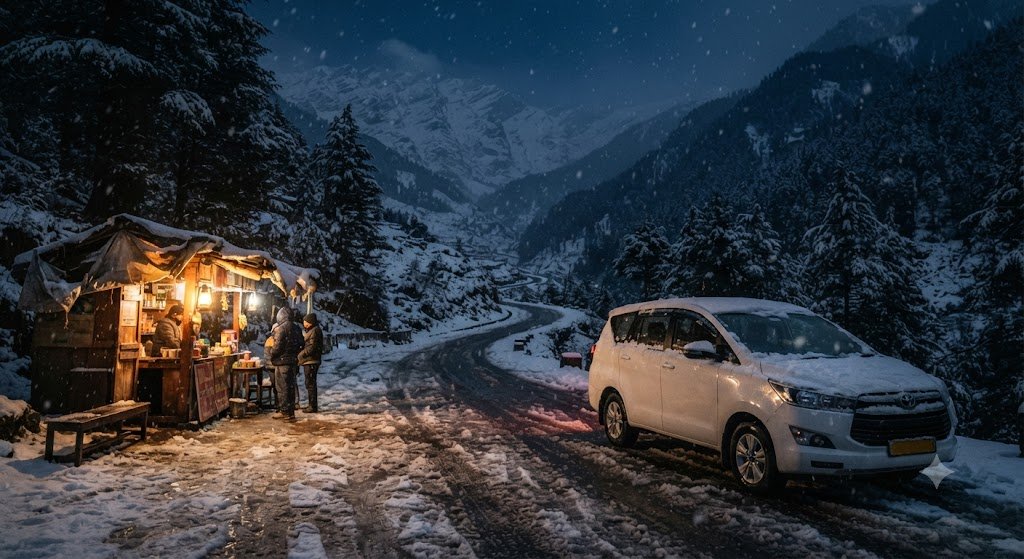
Taxi parked on a snowy mountain road near Manali with pine trees dusted white

Snowfall, the part that changes the car decision

Winter in Manali is genuinely beautiful, and families who plan it properly often say it was their favourite trip. But it changes two things, the road conditions and the car you need. Snow can close or slow the higher stretches, and a sedan with low ground clearance is not the right vehicle for a winter drive into snowy hill roads. This is why we recommend a larger, higher clearance car for any winter Manali trip, and why we advise checking current road conditions closer to your travel date rather than assuming the road is open the way it was in the summer.

Snow in Manali town itself is typically the attraction, but the final approach can be the difficult part, so a winter trip needs a driver who knows when to wait for conditions to improve and when to move, and a schedule that allows for a delay rather than a rigid arrival time.

Which car to book for Manali

For a Mohali to Manali trip, the car choice matters more than most people expect, because the road is long, climbs steadily, and narrows on the final stretch.

Car type Seats and luggage Why it works or does not for Manali
Sedan 4 seats, 3 bags Fine for a couple or small group in summer, less comfortable on long climbs and not ideal for winter
SUV 6 seats, 4 bags Good middle option for a family of five or six, better ground clearance than a sedan
Innova Crysta 7 seats, 4 bags Our most common recommendation for Manali, higher clearance and stability on winding roads, comfortable for a full family with luggage

Innova Crysta is what we most often recommend for this route, and it is the car we suggest for any winter trip. Its ground clearance, stability and boot space handle the winding hill roads and multi day luggage far better than a sedan or hatchback would.

Round trip is almost always the right booking

Almost every Manali booking we take is a round trip, and the reason is practical. A Manali visit is usually a multi day stay, and the car and driver waiting at the other end for the return leg is what makes the trip work without a second booking and a second wait at the hotel. A one way drop to Manali only makes sense if you are travelling onwards to Kullu, Kasol or further, or flying back out of the hills, and even then a round trip is often cheaper than booking two separate one way legs.

Because a round trip is billed against the total distance covered, with the 250 km per day minimum applied to each day of the itinerary, the honest way to budget is to think in terms of the whole trip rather than the single drive up. See our round trip outstation cab page for how this works in full.

Where the car takes you once you are in Manali

A round trip to Manali is not only the drive, the car and driver can take you through the local sightseeing that most families want, all within the same booking.

  • Solang Valley, for the views and optional adventure activities, a common half day outing from Manali town
  • Rohtang Pass, subject to road status and permits, which change with the season and conditions on the day
  • Old Manali, with its narrow lanes, cafes and river views, best explored on foot once the car drops you
  • Hadimba Temple, set among tall deodar trees, a short and easy visit
  • Atal Tunnel, a major engineering landmark on the route, worth a stop if your schedule allows

Tell us your planned sightseeing when you book so the driver builds it into the itinerary, rather than deciding stops on the road, since some high altitude spots like Rohtang Pass depend on permits and conditions that need checking in advance.

Manali as a base, or continuing on to Kasol and Kullu

Many visitors treat Manali as a base rather than the final destination, staying in town for several nights and making day outings to the surrounding valleys. Others combine it with onward stops, Kullu for its valley views and riverside walks, or Kasol, a village further along the Parvati valley that many younger travellers use as a quieter base. Both work well as multi stop additions to a round trip, and the itinerary is quoted as one trip rather than separate bookings. The key is telling us the full plan when you book, since each extra stop changes the total distance and the number of nights the driver stays away from base, both of which shape the quote.

What the first day in Manali should look like

The day you arrive is usually the most tiring, since the climb from the plains takes most of the afternoon and the arrival is often later than planned. A sensible first day is not a packed sightseeing schedule. Check into your hotel, take a short walk around the town centre if you have energy left, and keep the evening for an early meal and rest. The next morning is when you start the valley outings, with fresher legs and a clearer head for the drive to Solang or the walk through Old Manali. Building this into your plan stops the first evening from feeling like a rushed checklist.

Flying in and driving up is a common alternative

Bhuntar Airport, around 50 km from Manali town, is the closest airport to the hill station, but most travellers flying in from further away actually fly into Chandigarh and drive up from there with us, since the connections are more frequent and the flight plus drive often works out simpler overall. If your trip starts with a flight into Chandigarh, the car picks you up at the airport, and the drive to Manali follows the same route as described above.

Planning the drive itself for a stress free trip

Good planning on the day makes the difference between a tiring drive and an enjoyable one. Starting early keeps you clear of the worst of the afternoon traffic on the lower stretches and gives you daylight for the climb. Building in a meal break in the Kullu valley and a fuel stop gives everyone a chance to stretch, particularly children and older passengers who find long climbs tiring. And on any winter or monsoon trip, leaving a spare half day in the schedule means a delay on the road does not cascade into a missed hotel check in or a cancelled day of sightseeing.

Why the descent back to the plains needs as much care as the climb

Most families plan the drive up carefully and treat the return as an afterthought, which is a mistake on this route. The descent is hard on the brakes and on tired passengers, and a return leg started late in the day means coming down the steep stretches in fading light. Plan the return for a morning departure from Manali, the same way you planned the arrival, so the most demanding part of the road happens while everyone is fresh and the light is good. It is also the leg where a spare hour in the schedule matters most.

What to pack for Manali, depending on the season

Manali is noticeably cooler than the plains even in summer, and winter brings real cold. Warm layers are essential for any month from October to April, and a light jacket is worth carrying even in June, since evenings at altitude drop quickly. Waterproof outer layers matter during the monsoon, and sturdy footwear helps for any walking around Old Manali or Solang Valley. Carry any regular medication in slightly larger supply than you think you need, since weather delays on the road can add an extra night.

How this works with Flywings

We run the Mohali to Manali route regularly, and almost always as a round trip with the same car and driver for the whole stay. Tell us your travel dates, the number of people and bags, and whether you want sightseeing built in, and we will quote the full round trip with the season and car recommendation explained honestly. See our Mohali to Manali taxi page for the route details, or our Innova Crysta page for the car we most often suggest for this trip.

If you are planning a Manali trip and want an honest read on which month and car suit your group, message us on WhatsApp with your dates and we will tell you straight, including whether the road is likely to be comfortable for the exact week you have in mind.

Frequently asked questions

What is the best month to drive from Mohali to Manali?
Late March to June, or September to early November. These windows combine open roads, comfortable weather and fewer monsoon risks.

How long does the drive take?
About 7 hours 30 minutes of driving over 310 km, roughly 8 hours with stops. A same day return is not realistic.

Is the road open in winter?
Generally yes, though snow can slow or close higher stretches for periods. We advise on current conditions close to your travel date.

Which car is best for Manali in winter?
An Innova Crysta or a comparable higher clearance vehicle. A sedan is not the right choice for a winter drive into snowy hill roads.

Is a round trip cheaper than two one way bookings?
Usually yes for a Manali visit, since the car waits for the return leg at a lower round trip per km rate than two separate one way trips.

Can we add Solang Valley or Rohtang Pass to our booking?
Yes, tell us your sightseeing plan when you book. Rohtang Pass depends on permits and road conditions, so it should be checked in advance.

Should we fly into Chandigarh and drive up?
Often yes, since Chandigarh has more frequent connections and the car picks you up at the airport for the drive to Manali.

Is the monsoon a bad time to visit Manali?
July and August carry landslide and road blockage risk on higher stretches. It is workable with flexible dates and a spare day in the schedule, but not ideal for a tight itinerary.

Can the trip include Kasol or Kullu as well as Manali?
Yes, both work as multi stop additions. Tell us the full plan when you book, since each extra stop affects the total distance and the nights the driver is away from base.

How many days should we plan for Manali?
At least three to four nights for a relaxed visit covering the valley outings, with a fifth or sixth day if you want Solang, Old Manali and a Kullu day trip without rushing.

Is it safe to drive to Manali in winter?
With a suitable higher clearance car, an experienced driver and flexibility on timing, yes. We advise on current road conditions before you travel, and a spare day in the schedule helps if snow slows the final approach.

The one thing to remember

A Mohali to Manali trip is a full day of road in either direction, and the season decides how comfortable that road is. Pick a month when the road is open and the weather is kind, book a higher clearance car, and book the round trip so the car is waiting for you at the other end.

Driver Night Allowance Explained: When It Applies and How Much It Actually Costs

Two charges on an outstation quote get confused with each other more than any other line item, the night charge and the driver night allowance. They sound similar, both involve the word night, and both show up on trips that run late or stretch across several days. They are not the same thing, they apply under different conditions, and mixing them up is the single most common source of confusion we clear up on a booking call. Here is the full, honest explanation of the one that causes the most questions, the driver night allowance, what it actually pays for and when it genuinely applies.

The short answer

The driver night allowance is a charge that applies specifically on multi day outstation trips where the driver has to stay away from base overnight, typically on trips longer than 300 km covered in a single day. It is completely separate from the night charge, which applies to any trip with driving between 10 PM and 6 AM regardless of how many days the trip runs for. A same day Mohali to Delhi airport drop at 3 AM triggers a night charge but never a driver night allowance, since the driver returns to base the same day. A five day Himachal circuit triggers the driver night allowance on every night the driver is away, whether any of the actual driving that day happened after dark or not.

Why this allowance exists at all

A driver on a multi day outstation trip is not going home at the end of the day the way they would on a local or same day booking. They are staying in a hotel or guesthouse near your trip, away from their own base and their own family, for every night your itinerary runs. The driver night allowance compensates for exactly that, being away from home overnight for work, not for the act of driving after dark specifically. This is why it applies per night away, not per hour driven, and why it applies even on a day the car barely moved, a full sightseeing day in the middle of a multi day circuit still counts as a night away from base, exactly the same as a day spent covering real distance.

Night charge versus driver night allowance, side by side

Since these two get confused constantly, here is the direct comparison that clears it up.

Aspect Night charge Driver night allowance
What triggers it Any driving between 10 PM and 6 AM The driver staying away from base overnight
Applies on a same day trip Yes, if part of the trip falls in that window No, the driver returns to base the same day
Applies on a multi day trip Only if actual driving happens in that window Yes, for every night the driver is away, regardless of driving hours
How it is calculated A small fixed addition to the base fare Charged per night the driver stays away from base
Example that triggers only one A 3 AM Mohali to Delhi airport drop, same day return A five day Himachal circuit with early, daylight only driving

A trip can trigger both at once, a multi day circuit that includes a genuine pre dawn departure on one of its days sees both charges applied for that specific day, the night charge for the early driving and the driver night allowance for every night of the trip overall. Neither one is a substitute for the other, and neither one is optional padding, they compensate for two genuinely different things.

Which of our trips actually involve this allowance

Any trip where the car and driver are committed to you for more than one day involves this, which covers a lot of our regular bookings.

  • Multi day round trips to Manali, Dharamshala, Katra or Jaipur, wherever the itinerary runs more than a single day
  • The full tour packages, Himachal Circuit, Kashmir Valley, Rajasthan Heritage, Golden Triangle and the rest, all multi day by design
  • Char Dham Yatra, an eleven day circuit where the allowance applies for every night of the trip
  • The Spiti Valley circuit through Kunzum Pass, an eight day trip with the same nightly logic
  • Any wedding or corporate booking that happens to run across more than one day, the same rule applies regardless of the reason for the trip

What does not trigger it is anything where the car and driver return to base the same day, a local package, a same day round trip like Chandigarh to Shimla, or a one way drop, no matter how long or late that single day’s drive runs.

Why we cannot quote a single fixed number for every trip

Unlike our per km rates, which are the same regardless of route, the driver night allowance is not published as one fixed figure across every trip, since it reflects the actual number of nights your specific itinerary requires the driver to stay away. A three day trip and an eleven day trip naturally involve very different totals for this line item, even though the nightly logic behind each is identical. This is exactly why it appears in your written quote once your specific dates and itinerary are known, calculated for the actual nights involved, rather than as a generic number that would either overcharge a short trip or undercharge a long one.

How this is disclosed, and why that matters

Every multi day quote we send states the driver night allowance clearly, as its own line, before you confirm the booking. It is never added silently at the end of the trip. This matters more than it might sound, since a driver night allowance sprung on you after the trip is exactly the kind of surprise charge that makes a customer feel taken advantage of, even when the charge itself is entirely legitimate. Seeing it upfront, tied to the actual number of nights in your itinerary, is what turns a fair charge into one you can plan around rather than resent.

A worked example, so the logic is concrete

Take a four day, three night Himachal circuit as an example. The driver stays away from base for three nights across the trip, regardless of whether any single day’s drive happened to run past 10 PM. The driver night allowance applies for each of those three nights, shown as one line covering the full trip in your quote. If, on top of that, one of the days happens to start with a genuine pre dawn departure, that specific day also picks up the separate night charge for the early driving, shown as its own line rather than merged into the night allowance total.

What staying away from base actually looks like for the driver

It is worth understanding the practical reality behind this charge, since it makes the logic easier to accept. On a multi day trip, the driver arranges their own accommodation near wherever your itinerary has you staying each night, separate from your own hotel or guesthouse arrangements. This is not something you need to organise or pay for directly, the driver night allowance is exactly what covers this, a single line in your quote that accounts for it rather than a separate arrangement you have to think about. The driver is simply present and ready each morning for the next day’s drive, having handled their own overnight stay using the allowance built into your trip cost, the same practical arrangement any travelling professional makes when work keeps them away from home overnight.

Taxi driver resting beside his parked sedan on a quiet highway in the evening

Corporate and wedding bookings follow the same rule

This is not a leisure travel specific charge, it applies identically whenever a trip runs multi day regardless of the reason. A corporate booking that has a driver and car dedicated to a company event across several days out of town involves the same nightly allowance as a family holiday of the same length. A wedding that runs across multiple functions and multiple cities, with the same car and driver committed throughout, follows the identical logic. If your company or your event planning involves a multi day booking, this line item is worth budgeting for from the start rather than treated as a leisure travel quirk that would not apply to business or event travel, since the driver is away from home overnight regardless of whether the reason for the trip is a holiday or a work commitment.

What families and first time outstation travellers get wrong most often

The most common misunderstanding is assuming this charge is somehow avoidable by keeping all driving within daylight hours. It is not, since the allowance is about the driver being away overnight, not about when the wheels are moving. Families planning their first multi day trip sometimes push back on this line item expecting it to disappear if they plan a fully daylight itinerary, when in fact a perfectly daylight only four day trip still involves three nights away from base and the allowance that comes with it. Once this distinction is clear, the charge stops feeling like an unexplained add on and starts making straightforward sense, and it is one of those details worth understanding once properly rather than questioning fresh on every future multi day booking.

What happens if your trip runs longer than planned

Travel plans shift, a mountain road closes for a few hours, a family decides to add an extra day at a destination they are enjoying, a delayed start pushes the whole itinerary back. When a multi day trip genuinely runs an extra night beyond what was originally quoted, the driver night allowance for that additional night gets added honestly, the same way an extra night’s hotel stay would be for you. This is not a penalty, it is the same per night logic simply extended to match what the trip actually became. Telling us as soon as a plan changes means this is reflected clearly rather than becoming an argument about the final bill once the trip is already over.

Budgeting for this before you book a multi day trip

Since the total depends on the number of nights rather than being a flat figure, the most useful thing you can do while planning is settle your itinerary length as early as possible, even roughly, so the quote you receive reflects a realistic total rather than a placeholder. A firm eleven day Char Dham itinerary and a loosely planned trip that might run nine to twelve days depending on the weather are genuinely different things to budget around, and we would rather have that conversation honestly upfront than let you discover the range only once you are already on the road.

How this works with Flywings

Every multi day quote states the driver night allowance as its own clearly labelled line, calculated for the actual number of nights your itinerary involves, confirmed before you pay any advance. See our round trip outstation cab page for how multi day billing works in full, or our taxi fare guide for every charge that can appear on a trip, this one included.

If you are planning a multi day trip and want to know exactly what the driver night allowance adds to your specific itinerary, message us on WhatsApp with your dates and we will include it clearly in your written quote.

Frequently asked questions

Is the driver night allowance the same as the night charge?
No, the night charge applies to driving between 10 PM and 6 AM on any trip. The driver night allowance applies on multi day trips for every night the driver stays away from base, regardless of driving hours.

Does a same day return trip ever involve a driver night allowance?
No, the driver returns to base the same day on a same day return, so this allowance never applies there, even on a very long single day.

How many nights does the allowance apply for on a multi day trip?
For every night the driver stays away from base across your itinerary, shown as one total in your written quote based on your actual travel dates.

Can I avoid this charge by planning only daylight driving?
No, the allowance is triggered by the driver being away overnight, not by driving after dark, so a fully daylight itinerary across several days still involves it.

Is this charge disclosed before I book, or added at the end?
Always before, as its own clearly labelled line in your written quote, confirmed before any advance payment.

Can both the night charge and the driver night allowance apply on the same trip?
Yes, if a multi day trip includes a day with genuine early morning or late night driving, that day can carry both charges, each shown separately.

Does the allowance apply to every trip length the same way, or does it scale?
It scales with the actual number of nights in your itinerary, a longer trip naturally involves a higher total than a shorter one, since more nights away are involved.

Does this apply to tour packages like Char Dham or Spiti as well?
Yes, any multi day trip, including full tour packages, involves the driver night allowance for every night of the itinerary.

Where does the driver actually stay overnight on a multi day trip?
Near wherever your itinerary has you staying each night, arranged by the driver themselves. This is exactly what the allowance covers, you do not need to organise or pay for it separately.

Does a multi day corporate or wedding booking involve this allowance too?
Yes, the rule is identical regardless of why the trip is multi day, a company event or a wedding running across several days and cities involves the same nightly allowance as a family holiday of the same length.

What happens if our trip runs an extra night beyond what was quoted?
The allowance for that additional night is added honestly, the same per night logic simply extended, and telling us as soon as your plan changes keeps this clear rather than a surprise at the end.

Should we settle our exact itinerary length before asking for a quote?
As early and firmly as you reasonably can, since the total depends on the number of nights. A rough range is fine too, we would rather discuss that honestly upfront than have you discover it only once you are travelling.

The one thing to remember

The driver night allowance and the night charge answer two different questions, one is about how many nights the driver spends away from base, the other is about whether any driving happens between 10 PM and 6 AM. Know the difference, and a multi day quote that lists both stops looking like a padded bill and starts looking like exactly what it is, an honest breakdown of two separate, real costs, each there for a genuine reason rather than padding.

State Border Tax and Permit Charges Explained: What Adds to Your Taxi Bill Crossing States

Toll gets asked about on almost every booking call, since it is the one extra charge most people already expect. State border tax and permit charges come up far less often, mostly because people do not realise their route even crosses a state line until the question comes up on a call, or worse, until it shows up as a line item they were not expecting. Since a good number of our regular routes do cross at least one state border, this is worth explaining properly rather than leaving it as a vague mention buried in the terms, so you know exactly what to expect on your specific route before you book.

The short answer

State border tax and permit charges are a real, separate cost from toll, charged when a vehicle registered in one state crosses into another for a commercial trip. Not every route we run crosses a border, and the ones that do vary in how many states they cross. Like toll, this is charged at actual cost with a receipt, never folded into a fixed number we quote in advance, since the exact charge depends on the state, the vehicle type and sometimes the specific checkpost the driver clears it at.

Why this is a separate charge from toll in the first place

Toll pays for the specific road or bridge you are using, collected at a plaza regardless of which state the vehicle is registered in. State border tax works on a completely different logic, it is a state government charge on a commercial vehicle registered elsewhere entering that state to operate, essentially a fee for using that state’s roads commercially rather than just passing through as a private vehicle would. The two charges exist for different reasons, get collected at different points, and neither one substitutes for the other. A route that crosses two state lines can involve toll at several points along the way plus a separate permit charge for each state entered, and treating the two as interchangeable is exactly how a customer ends up surprised by a total that looked lower on paper than it turned out to be.

Which of our regular routes actually cross a state border

This is the part worth knowing before you book, since it is not always obvious from the city name alone. Some of our most requested routes stay entirely within Punjab and Chandigarh, others cross one or more state lines.

Route States crossed Border tax likely to apply
Chandigarh to Amritsar Stays within Punjab and Chandigarh throughout No
Chandigarh to Shimla Punjab and Chandigarh into Himachal Pradesh Yes, one state line
Mohali to Manali Punjab and Chandigarh into Himachal Pradesh Yes, one state line
Chandigarh to Dharamshala Punjab and Chandigarh into Himachal Pradesh Yes, one state line
Chandigarh to Dehradun Punjab and Chandigarh through Haryana into Uttarakhand Yes, potentially more than one state line
Chandigarh to Delhi Punjab and Chandigarh through Haryana into Delhi NCT Yes, potentially more than one state line
Chandigarh to Jaipur Punjab and Chandigarh through Haryana into Rajasthan Yes, potentially more than one state line
Chandigarh to Katra Punjab and Chandigarh into Jammu and Kashmir Yes, one state line

Notice that Amritsar is the one major route on this list that stays entirely inside Punjab, no border tax applies there at all, while everything heading towards the hills, Delhi, Rajasthan or Jammu crosses at least one state line. This is exactly the kind of detail that explains why two routes of similar distance can have noticeably different total costs once every charge is added up, and it is worth checking against this table before assuming any two hill or outstation routes will cost roughly the same.

Why we cannot publish a fixed rupee number for this

Unlike our per km rates, which are entirely within our control and published openly, state border tax is set by each state government, varies by vehicle category, and is revised from time to time without much advance notice. Quoting a fixed number here would mean either overcharging you on a day the actual rate is lower, or quietly absorbing a loss on a day it is higher, and either way it would not be the transparent pricing this site is built around. This is exactly why it sits in the same category as toll, charged at actual cost with a receipt, confirmed as part of your written quote once the route is known, rather than baked into an advertised rate that may not hold on the day.

How this actually shows up on your quote

When your route crosses a state border, the quote you receive states this clearly as a separate line, an estimate based on current rates for your vehicle category, alongside the base per km fare and any toll on the route. This is not a surprise add on at drop off, it is part of the same upfront written quote process every trip on this site goes through. If the actual charge at the checkpost differs slightly from the estimate, you see the receipt, the same way you would for toll.

Charge What it pays for How it is billed
Per km fare The car, driver and fuel for your route Fixed rate, quoted upfront, never changes
Toll Specific roads, highways and bridges used At actual cost with receipt, estimated in advance
State border tax and permit Commercial entry into a state your vehicle is not registered in At actual cost with receipt, estimated in advance, only when your route crosses a state line

What actually happens at the checkpost itself

For most passengers, this entire process is invisible. The driver handles the paperwork and payment at the actual border checkpost, a brief stop of a few minutes while documents are checked and the charge is paid, the same way a toll plaza stop works. You do not need to carry any documents for this yourself, produce anything, or step out of the vehicle in the ordinary case. The only thing worth planning around is the stop itself adding a small amount of time to your journey at that specific point, worth factoring in if your schedule is tight around a flight or an event, the same way you would factor in a toll plaza queue.

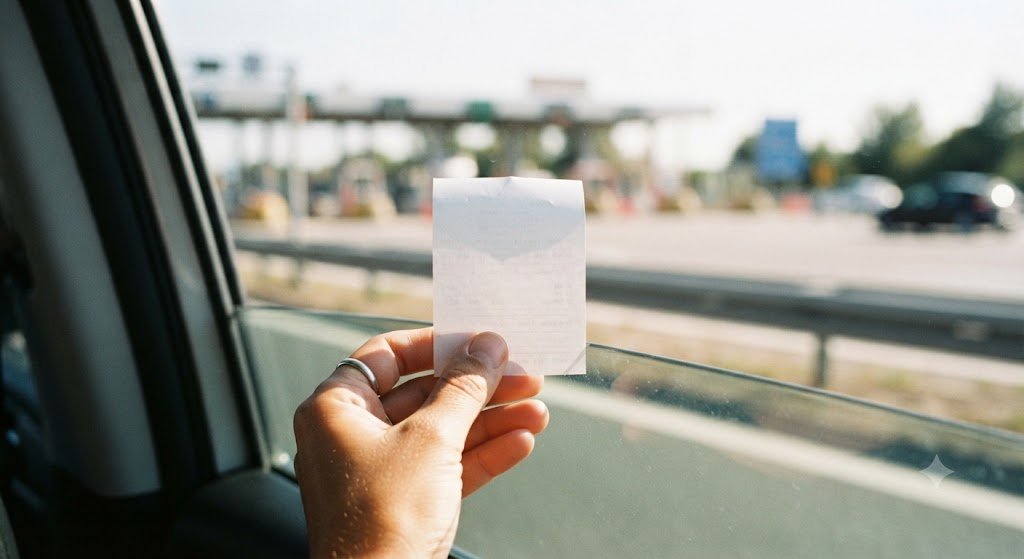
Hand holding a printed receipt near a car window on a highway

How this compares to how other operators handle it

This is one of the charges where operator transparency varies the most in our experience. Some quote a suspiciously round, low headline rate and simply do not mention state border tax until it appears on the final bill, letting the customer discover it only once the trip is already underway and there is no real option to push back. Others fold an inflated, padded estimate into the base fare to avoid the conversation entirely, which usually means you are overpaying on routes that do not even cross a border. Neither approach is honest. Telling you plainly which routes cross a state line, giving a real estimate for the ones that do, and showing the actual receipt afterward is simply the more straightforward way to do this, even though it means a slightly more involved conversation upfront than just quoting one flat number.

Does this apply differently by car type

Yes, and this is another reason a fixed number does not work here. State permit charges are generally structured around vehicle category and seating capacity, meaning a sedan and a Tempo Traveller crossing the exact same state line can attract different charges. This is factored into the estimate you receive for your specific car type, not a flat number applied regardless of which vehicle you book.

What this means for a multi state circuit like Char Dham or Rajasthan

Multi day circuits that cross several states in one trip, a Rajasthan Heritage tour or the Char Dham Yatra for instance, can involve more than one state border charge across the itinerary rather than just one. This is exactly why the written quote for a multi day trip lists these separately rather than as one bundled guess, so you know which state each charge belongs to and can see it reflected honestly rather than as an unexplained lump sum.

Why the return leg matters just as much as the outbound leg

A detail worth planning for on a round trip is that a state border charge is not always a one time cost for the whole journey, depending on the specific state and permit type, it can apply again on the way back through the same checkpost, since the vehicle is once again entering a state it is not registered in, just in the opposite direction. This is not universal across every state, some permits cover a return leg within a set window, others do not, which is exactly why the estimate you receive is built around your actual round trip plan rather than a one way assumption. Tell us upfront whether your trip is one way or a round trip when you book, since that genuinely changes what a fair estimate for this charge looks like.

Planning ahead for a route you know crosses a border

If you already know your trip involves a state border, whether from the table above or simply because your destination is in another state, there is not much you personally need to prepare beyond being aware it will appear as a line item. Unlike toll, where alternate routes occasionally offer a cheaper path, state border tax on a commercial vehicle does not really have a workaround, every legitimate route crossing that state line involves it in some form. The only real preparation on your end is asking for the estimate upfront if it was not already part of your quote, and building a few minutes of buffer into a tight schedule for the checkpost stop itself.

Common misunderstandings worth clearing up

A few myths about this charge come up often enough to address directly.

Myth: it is the same as toll, just under a different name. It is not. Toll is paid for using a specific road regardless of where your vehicle is registered. State border tax is specifically about commercial entry into a state from outside it, a different government, a different purpose, collected separately.

Myth: it applies on every outstation trip regardless of route. It does not. As the table above shows, a route like Chandigarh to Amritsar never crosses a state line, so this charge simply does not apply there.

Myth: operators who do not mention it upfront are hiding a lower total cost. Usually the opposite. Leaving it out of the initial conversation is a common way an operator’s headline number looks lower than it actually ends up being once every real charge is added at the end.

How this works with Flywings

Every quote we send states plainly whether your specific route crosses a state border, and if it does, includes an honest estimate for the permit charge based on current rates for your vehicle category. See our taxi fare guide for the complete breakdown of every charge that can appear on a trip, this one included, or check the individual route page for your trip, such as our Chandigarh to Jaipur taxi page or Chandigarh to Dehradun taxi page, for route specific detail.

If you have a route in mind and want to know upfront whether a state border charge applies and roughly what to expect, message us on WhatsApp with your pickup and drop city and we will tell you honestly before you book.

Frequently asked questions

Is state border tax the same as toll?
No, toll pays for using a specific road or bridge. State border tax is a separate charge for a commercially registered vehicle entering a state it is not registered in.

Does every outstation route from Chandigarh or Mohali cross a state border?
No, Chandigarh to Amritsar, for example, stays entirely within Punjab and Chandigarh, so no border tax applies on that route.

Why can’t you tell me the exact rupee amount before I book?
State governments set and revise these rates independently of us, and the amount can vary by vehicle category. We give you an honest estimate based on current rates and show you the actual receipt once paid.

Does the charge differ by car type?
Yes, state permit charges are generally structured around vehicle category and seating capacity, so a sedan and a larger vehicle crossing the same border can be charged differently.

Can a single trip cross more than one state border?
Yes, routes like Chandigarh to Delhi or Chandigarh to Jaipur pass through more than one state, and each border crossed can carry its own charge.

Is this charge included in the per km rate shown on the site?
No, the per km rate covers the car, driver and fuel only. State border tax, like toll, is charged separately at actual cost.

Will I see a receipt for this charge?
Yes, the same way you would for toll, the actual amount paid at the checkpost is shown to you as part of your trip costs.

Do I need to do anything myself at the state border checkpost?
No, the driver handles the paperwork and payment, you do not need to carry documents or step out of the vehicle in the ordinary case.

How much extra time does a border checkpost stop add to the trip?
Usually just a few minutes, similar to a toll plaza stop, worth a small buffer if your schedule is tight around a flight or event.

Does the charge apply again on the return leg of a round trip?
Depending on the specific state and permit type, it can. Tell us whether your trip is one way or round trip when you book so the estimate reflects your actual plan.

Is there a cheaper alternate route that avoids the state border charge?
Generally no, unlike toll, every legitimate route crossing that state line involves this charge in some form for a commercially registered vehicle.

Does a multi day circuit like Char Dham involve more than one of these charges?
Yes, a multi state circuit can cross several borders across the full itinerary, and the written quote for that trip lists each one separately rather than as a single guessed total.

The one thing to remember

State border tax is a real, separate charge from toll, and it only applies when your specific route actually crosses a state line, which not every trip does. We cannot quote a fixed rupee figure for it since state governments set and change these rates independently, but every quote states honestly whether it applies to your route and gives you a real estimate before you book, with the actual receipt to follow. Ask upfront, and there is nothing left to discover once you are already on the road.

Same Day Return vs Multi-Day Outstation Trip: Which Booking Type Do You Need?

This question is different from the one people usually ask us first. Most callers start by asking about one way versus round trip, which is really a question about how the fare gets calculated. This one is about something else entirely, whether your actual travel plan should be a same day return at all, or whether you are quietly setting yourself up for an exhausting single day when a proper multi day trip would serve you far better and cost you very little extra to actually enjoy.

Here is how we actually help people figure this out, route by route and situation by situation, with the real drive times behind the decision rather than a vague rule of thumb.

The short answer

A same day return works when your destination is close enough that the driving itself does not eat the whole day, roughly under four hours each way as a rule of thumb, and when you genuinely do not need or want an overnight stay. A multi day outstation trip is the right call the moment either the distance makes a same day round trip exhausting rather than relaxing, or your actual plan needs more than a few hours at the destination. Getting this choice right matters more than which fare structure you pick, since the wrong trip length ruins a day out far more thoroughly than a slightly higher fare ever could.

The real test, not just distance

Distance alone does not fully answer this, since what matters is how much time you have left at the destination once the driving is accounted for. A same day trip that leaves you two rushed hours at your destination after a long drive each way is technically a same day return, but it rarely feels worth having done. The better test is this, after subtracting your total drive time from a comfortable waking day, do you still have at least four to five hours to actually do what you went there for. If yes, same day works. If the honest answer is barely two or three hours, you are better off either picking a closer destination or accepting that this trip needs a night away.

Real routes, sorted by which category they actually fall into

Rather than leave this abstract, here is how our own regular routes from the tricity actually sort into same day and multi day, based on real drive times.

Route One way distance and time Best fits as
Chandigarh to Shimla 113 km, about 3h 15m Comfortable same day return, see our full Shimla same day return guide
Chandigarh to Amritsar 230 km, about 4h 15m Workable as a long same day trip if you start early, more relaxed as an overnight
Chandigarh to Dharamshala 245 km, about 5h 30m Better as an overnight, a same day round trip here is a genuinely long day
Chandigarh to Dehradun 165 km, about 4h Borderline, doable same day but comfortable as an overnight if continuing to Mussoorie or Rishikesh
Mohali to Manali 310 km, about 7h 30m Multi day trip, a same day round trip is not realistic
Chandigarh to Katra 360 km, about 7h Multi day trip, especially once darshan time at the shrine is added
Chandigarh to Jaipur 520 km, a long single day drive Multi day trip, almost always booked as part of a longer Rajasthan circuit

Notice the pattern, anything under about 250 km one way is a realistic same day candidate if you start early, and anything meaningfully past that turns into a trip that needs at least one night to actually feel worth it.

Why an early start matters more than almost anything else

Across every borderline route on the table above, the single biggest lever you actually control is your departure time, not the car you book or how tightly you plan the day. Leaving even ninety minutes earlier than your natural instinct turns a tight same day return into a comfortable one, since it buys back exactly the buffer that a late start eats first. This is worth internalising before you even get to the same day versus multi day question, since a genuinely early start can occasionally shift a route from the tighter category into the comfortable one, while a late start does the opposite even on a route that should have been easy.

How the billing actually differs between the two

Beyond comfort, the two trip types are billed differently in a way worth understanding before you book.

Aspect Same day return Multi day outstation
Minimum billable distance 250 km for that one day, round trip rate 250 km per day, round trip rate, calculated across the whole itinerary
Driver night allowance Does not apply, driver returns to base the same day Applies for every night the driver stays away from base, on trips longer than 300 km in a day
Car and driver commitment Released back to other bookings once you are home Dedicated to your trip for every day of the itinerary, including days spent sightseeing rather than driving

This is exactly why a multi day trip is quoted as a per day dedicated hire rather than a simple distance calculation, the car and driver are committed to you alone for the full duration, not released to pick up other trips between your outbound and return legs.

When a same day trip quietly becomes the wrong choice

The most common mistake we see is not picking the wrong trip type outright, it is picking same day for a route that is right on the edge, then discovering on the day that the math did not work in your favour. Chandigarh to Amritsar and Dharamshala both fall in this zone. They are technically doable as a same day round trip, but only if you leave early, keep sightseeing tight, and accept a late return. If your group includes elderly parents or young children, or if you actually want a relaxed few hours rather than a tightly scheduled few hours, the same distance is far more enjoyable spread across an overnight instead.

When a multi day trip is worth it even for a shorter distance

The reverse mistake happens too, treating every trip as same day by default even when the destination itself deserves more time. Dehradun is a good example, the drive itself is same day feasible, but if your actual plan includes Mussoorie or Rishikesh as well, trying to cram all of that into one day from the tricity turns a pleasant few days into a rushed blur. If your destination is a gateway to something bigger rather than the whole plan, that is usually a sign to book the extra night rather than force a same day return.

Packing and planning differently for each trip type

The two trip types also deserve genuinely different preparation, not just a different fare structure. A same day return needs almost nothing beyond what you would carry for a normal day out, water, snacks, a light jacket if the destination sits at any elevation. A multi day trip is a different exercise entirely, an overnight bag, a change of clothes for the climate at your actual destination rather than the tricity’s weather, and any regular medication carried in a slightly larger supply than you think you need, since a weather delay or a tired travel day can push a return home by an extra day without much warning.

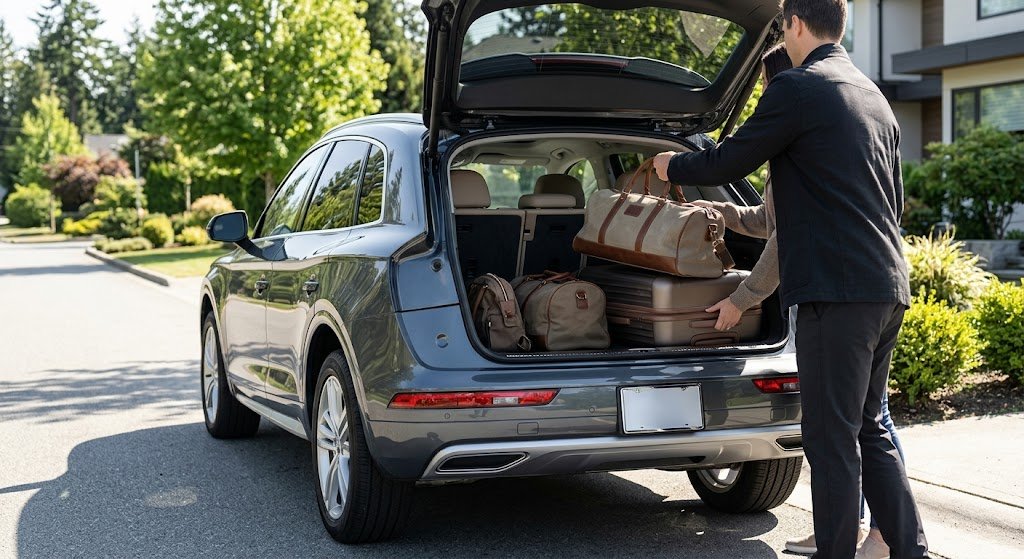
Overnight travel bag and suitcase being loaded into an SUV trunk

This sounds obvious written out, but it is the single most common thing families get wrong on a route that sits right on the edge, like Dharamshala or Amritsar, packing as if it were a day trip and then either extending unplanned or pushing through an uncomfortable same day return because packing for an overnight was not on the radar.

What past customers on borderline routes have told us

A pattern comes up often enough on the Amritsar and Dharamshala routes specifically that it is worth passing on directly. Families who did the same day version and pushed through a long day generally say afterward that they wished they had built in the extra night, mainly because the return leg after a full day of sightseeing feels far longer than the outbound leg did that morning. Families who booked the overnight from the start, even when a same day return was technically possible, almost never say they wish they had saved the hotel cost by rushing it into one day. This is not a universal rule, plenty of same day trips on these routes go fine, especially for a fit group with an early start, but it is worth weighing honestly against your own group’s energy for a long day rather than assuming it will feel the way it looks on a distance table.

What to actually tell us so we can recommend correctly

We would rather steer you towards the right trip length than simply confirm whatever you first ask for, since a bad same day experience reflects on us as much as it does on your day out.

  • Your actual destination and what you plan to do once you arrive, not just the city name
  • Who is travelling, since elderly parents or young children change how much driving in one day is genuinely comfortable
  • Whether you are open to an overnight if the honest math favours it
  • Your preferred departure time, since an early start is what makes several borderline routes work as same day at all
  • Whether the destination is your whole plan or a gateway to somewhere further

Tell us this and we will say plainly if your planned same day trip is genuinely comfortable, workable but tight, or better off as an overnight, rather than just pricing whatever you originally asked for.

When the destination itself decides the trip is multi day, not the distance

A separate category worth mentioning is the trip that is multi day by nature regardless of how the distance table reads, a genuine pilgrimage or high altitude circuit like Char Dham or the Spiti Valley circuit through Kunzum Pass. These are not same day versus multi day decisions at all, they are structured as multi day per day dedicated hires from the start, since the itinerary itself involves several stops, treks and overnight halts that no amount of early starting turns into a single day. If your trip falls into this category, the question this page answers does not really apply, the itinerary decides the trip length, not a comparison against a same day alternative. It is worth knowing this distinction exists so you do not spend time weighing a same day option against a trip that was never going to fit into one day in the first place.

How this works with Flywings

Whichever trip length actually suits your plan, the underlying process is the same, a written quote before you book, the driver name and vehicle number confirmed the evening before, and the round trip per km rate with its minimum distance rule applied honestly to whichever itinerary you choose. See our round trip outstation cab page for the full rate table and how multi day billing works, including the driver night allowance.

If you are not sure whether your trip should be a same day return or a proper overnight, message us on WhatsApp with your destination and your travel dates and we will give you an honest read before you commit to either.

Frequently asked questions

What is a reasonable one way drive time for a same day return?
Under about four hours each way is comfortable. Beyond that, a same day round trip becomes more about the drive than the destination.

Does the driver night allowance apply on a same day trip?
No, it only applies when the driver stays away from base overnight, which is not the case on a same day return.

Is a multi day trip always more expensive than doing the same distance as two same day trips?
Not necessarily, and the two are rarely a real alternative to each other since a multi day trip usually covers a destination too far for a comfortable same day round trip in the first place.

Can a booking start as same day and change to an overnight if we decide we want to stay?
Yes, tell us as early as possible, we would rather adjust the plan than have you rush back to meet an original schedule that no longer suits you.

Which of your regular routes are best suited to a same day return?
Chandigarh to Shimla is the most comfortable. Amritsar and Dharamshala are workable with an early start but tighter.

Is Manali ever realistic as a same day trip from the tricity?
No, at 310 km and roughly 7 hours 30 minutes each way, this is a multi day trip, a same day round trip would mean almost 15 hours of driving alone.

How do you decide if our group should do a route as same day or overnight?
We look at the actual drive time, who is travelling, and what you plan to do at the destination, then tell you honestly which option leaves you with a trip you will actually enjoy.

Does booking a multi day trip mean the car is unavailable to us during the day too?
No, the opposite, the car and driver are dedicated to your trip for the full duration, including days you spend sightseeing rather than driving.

What should we pack differently for a multi day trip versus a same day return?
An overnight bag, climate appropriate clothing for the actual destination, and a slightly larger supply of any regular medication, since a weather delay can add an unplanned extra day.

Do most families regret doing a borderline route like Amritsar or Dharamshala as a same day trip?
Not universally, but families who push through a long same day return on these routes more often say afterward they wished they had booked the extra night, mainly because of how tiring the return leg feels after a full day out.

Is Char Dham or the Spiti circuit a same day versus multi day decision too?
No, these are structured as multi day per day dedicated hires from the start, the itinerary itself, including treks and overnight halts, decides the length, not a comparison against a same day option.

The one thing to remember

The right question is not one way versus round trip, it is same day versus multi day, and the honest answer depends on how much time driving actually leaves you at your destination, not just the raw distance on a map. Routes under about four hours each way generally work well as a same day return, anything meaningfully past that deserves at least one night to actually feel worth the trip. When your route sits right on that edge, ask us honestly rather than guessing, since we would rather talk you into the option you will actually enjoy than simply confirm whatever you first requested.

One Way Taxi Pickup From Mohali: Phase-Wise Pickup Points and What to Expect

A one way taxi booking from Mohali sounds simple right up until you actually try to describe where you are. Mohali is not one compact block, it is a mix of the older numbered phases, newer sector style developments, and the growing edge towns of Kharar and Landran, and a pickup point that is obvious to you is not always obvious to a driver who has not been to your exact street before. This is the practical side of booking a one way taxi that most guides skip entirely, so here it is properly laid out, area by area, with what genuinely changes and what does not, so you know exactly what to say before the driver is even on the way.

The short answer

One way taxi pickup works the same way across every part of Mohali, the rate, the process and the driver network are identical whether you are in Phase 3B2 or out past Landran. What actually changes phase to phase is how precisely you need to describe your pickup point, since Mohali’s mix of numbered phases, sector style zones and newer developments is genuinely confusing even for people who have lived here a while, and a vague pickup description is the single most common reason a driver takes longer to find you.

Why Mohali’s layout trips people up

Mohali grew in two distinct waves, and it shows in how the city is addressed. The older part of the city uses numbered phases, Phase 1 through Phase 11, laid out as a grid where each phase is its own self contained neighbourhood. The newer part of the city, built after the original master plan filled up, uses Chandigarh style sector numbers instead, Sector 61 and upward, which is where our own office sits alongside a lot of the newer commercial development. On top of both of these, Kharar and Landran on the western edge have grown fast enough that they now generate a steady stream of bookings of their own, despite technically sitting just outside the original city limits.

None of this is a problem once you know which system your address falls under, but if you are new to Mohali or booking on someone else’s behalf, mixing up a phase number and a sector number is an easy mistake to make, and it is exactly the kind of mix up that delays a pickup. Even long time residents occasionally give an old phase number for an address that has since been reclassified under the newer sector system, which is harmless as long as a landmark comes along with it.

What to tell us for a smooth pickup, by area type

The fix is simple once you know what actually helps. Being specific in the right way costs you nothing extra and saves real time on the day.

Area type What to specify Why it matters
Older numbered phases, Phase 1 to Phase 11 The exact phase number plus a nearby market or gurudwara if you have one Each phase is laid out as its own grid, a phase number alone can still mean a long internal road to navigate
Newer sector areas, Sector 61 and above, including the IT Park belt The sector number and, for a commercial pickup, the building or tower name This area mixes offices, IT parks and residential towers close together, a building name resolves ambiguity fast
Kharar and Landran The specific colony or the nearest known landmark, since these areas are growing fast New construction here means map pins are not always accurate yet, a landmark is more reliable than an address alone

Whichever category your pickup falls into, the driver assigned to you gets this detail before the trip, not worked out on the fly once they are already near your area.

How this actually plays out for a first time visitor to the city

If you are visiting Mohali rather than living here, none of this needs to feel like homework before you can book a taxi. Give us whatever address you have, a hotel name, a friend’s flat, an office you are visiting, and mention it is your first time in the city. We will ask the follow up questions that pin down the exact pickup point rather than expecting you to already know the phase versus sector distinction, and the driver still gets a precise location before setting out, the extra step just happens on our end of the call instead of yours. This is genuinely the more common scenario for us than it might sound, a large share of our Mohali pickups are for people visiting rather than living here.

Why the IT Park belt deserves its own mention

The stretch of newer sectors around our own office has grown into Mohali’s main commercial and IT hub, and it behaves differently from a purely residential phase for one specific reason, shift change traffic. A pickup timed right around when a large office empties out takes noticeably longer for a driver to navigate than the same pickup an hour earlier or later, purely because of how much local traffic that shift change generates on the internal roads. If your one way trip starts from this belt, telling us your actual departure time rather than a rounded estimate helps us account for this rather than assume a quiet residential pickup.

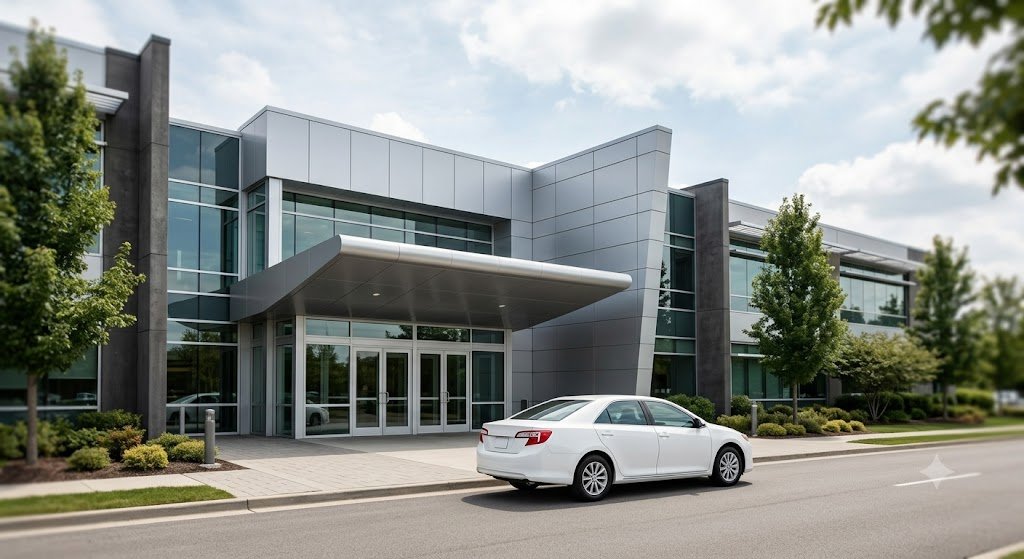
IT office park building in Mohali with a sedan taxi parked at the entrance

Why wedding season adds its own local wrinkle

Punjab’s wedding season, broadly October through February, hits certain phases harder than others simply because of where the popular banquet halls and gurudwaras sit. A Saturday booking from a phase with a major wedding venue in it can mean genuinely slower local roads for reasons that have nothing to do with your trip specifically. This is not a reason to avoid booking, it is a reason to build a little extra time into your pickup window if your date and area happen to overlap with a big wedding function nearby. If you are booking well ahead and know your date falls in this window, mentioning it upfront lets us factor it into the pickup time we suggest rather than you discovering the slow patch on the day itself.

One way pricing does not change by area

To be clear about the part that never changes regardless of which phase, sector or edge town you are booking from, the per km rate is identical everywhere in Mohali.

Car type One way starting rate
Hatchback Rs 10 per km
Sedan Rs 11 per km
SUV Rs 14 per km
Innova Crysta Rs 18 per km

A one way trip is billed against the actual road distance from your pickup point to your drop city, subject to the 130 km per day minimum. Your exact phase or sector only affects the starting point of that distance calculation, never the rate itself.

One way trips to Chandigarh airport, Mohali’s most common single booking

A large share of one way bookings out of Mohali are simply a drop to Chandigarh International Airport, which sits about 10 km from most parts of the city, one of the shortest airport runs on this site, roughly 20 to 25 minutes outside peak traffic. Because this is such a common trip, it is worth a specific mention here, the same pickup point precision advice applies, but with one extra detail, your flight time. Airport drops get built around your actual departure time with a sensible buffer, not a generic estimate, and if your flight time shifts, telling us as early as possible means the pickup adjusts with it rather than leaving you stuck with an old schedule.

If your pickup falls in the IT Park belt specifically, an early morning flight often means leaving before the worst of the office traffic even starts, which works in your favour, while a mid morning flight can mean threading through exactly the shift change traffic mentioned above, worth an extra buffer of fifteen to twenty minutes if your schedule allows it.

Corporate one way pickups from the IT Park belt

Beyond individual airport runs, a meaningful share of our one way bookings from this part of Mohali are corporate, an employee heading to the airport for a business trip, a client being dropped after a meeting, a same day one way run between offices. These work exactly the same way as any other one way booking, with one addition, a company with regular travel from this belt benefits from setting up a corporate account rather than booking fresh each time, since it adds a locked in rate card and priority allocation for exactly this kind of short notice request. See our corporate cab service page if this pattern sounds like your team’s.

What actually happens once you confirm a pickup point

Once your pickup detail is locked in, whichever area of Mohali it falls in, the process from there is identical to any other one way booking on this site. We check availability with partner operators on your route, send a written quote, usually within ten minutes, and confirm the driver name, phone number and vehicle number the evening before your trip. The driver reaches your exact pickup point with that information already in hand, not figuring out the area for the first time on the day.

What if your trip is local rather than one way outstation

Not every trip that starts in Mohali is a one way drop to another city. A lot of genuine local running around, moving between phases for a full day of errands or meetings, a half day covering a few sectors, is better booked as the local 8 hour, 80 km package rather than a one way fare, since it is priced for exactly that kind of stop and start day rather than a single point to point drop. The same pickup point precision advice above applies just as much here, if anything more, since a local package can involve several stops across different phases and sectors in one booking, and a driver who has the full run of stops mapped out in advance moves through the day far more smoothly than one figuring out the next stop as you go.

A quick checklist before you book

  • Know whether your address uses a phase number or a sector number, and give whichever one actually applies
  • Add a nearby landmark if your street is not a main road, especially in Kharar or Landran
  • Give your actual departure time if you are booking from the IT Park belt, particularly around typical shift change hours
  • Mention if a major local event or wedding function is happening near your pickup point on your travel date
  • Confirm your pickup detail again the evening before when the driver details are shared, rather than assuming it carried over correctly

How this works with Flywings

Every one way booking out of Mohali runs through the same booking desk regardless of which phase, sector or edge town you are in, and we ask for the pickup detail upfront specifically so the driver is not guessing on the day. See our one way taxi service page for the full rate table, or our Mohali taxi service page for local coverage and office details.

If you are booking a one way trip from anywhere in Mohali and are not sure how to describe your exact pickup point, message us on WhatsApp with your area and we will confirm the fastest way to get a driver to you.

Frequently asked questions

Does the one way rate change depending on which phase I am in?
No, the per km rate is identical across every phase, sector and edge area of Mohali. Only the actual distance to your drop city affects the fare.

What is the difference between a phase and a sector in Mohali?
Phases are the older numbered neighbourhoods, Phase 1 through Phase 11. Sectors, numbered from 61 upward, cover the newer development including the area around our own office.

Do you cover Kharar and Landran for one way pickups?
Yes, both are part of our regular coverage, though giving a specific landmark helps since new construction there is not always reflected accurately on maps yet.

Is a pickup from the IT Park area slower during shift change hours?
It can be, purely due to local traffic volume at that time, not availability. Telling us your actual departure time helps us plan around it.

What if I do not know whether my address is a phase or a sector?
Give us your address as you have it and mention a nearby landmark, we will work out which system it falls under and confirm the pickup point with you before the trip.

Does wedding season affect one way pickups the same way it affects other bookings?
Yes, a Saturday pickup near a major wedding venue can mean slower local roads. It is worth building a little extra time in if your date and area overlap with a wedding function.

Can I change my pickup point after booking if my plan shifts slightly?
Yes, tell us as soon as you know, a small change within the same general area is straightforward to update before the driver is dispatched.

Will the driver call before arriving if they cannot find my exact location?
Yes, you get the driver’s phone number the evening before specifically so this kind of last mile coordination is easy on the day.

How far is my one way trip to Chandigarh airport from Mohali?
About 10 km from most parts of the city, roughly 20 to 25 minutes outside peak traffic, one of the shortest airport runs we do.

Should my company set up a corporate account for regular one way airport runs?
If your team books this kind of trip often, yes, a corporate account locks in a rate card and gives priority allocation for short notice requests, which matters more for business travel than personal trips.

Should a full day of errands across multiple Mohali phases be booked as one way or local?
Local, the 8 hour 80 km package is priced for exactly this kind of multi stop day, a one way fare only covers a single pickup to a single drop.

Can one booking cover multiple stops across different phases in a single day?
Yes, under the local package, tell us your full list of stops when you book so the driver has the whole day mapped out rather than working stop by stop.

The one thing to remember

A one way taxi from Mohali is priced and processed the same way no matter which phase, sector or edge town you are in, the only thing that genuinely varies is how precisely you need to describe where you actually are. Get that one detail right, phase or sector, plus a landmark if you need one, and the rest of the booking runs exactly the same as it would from anywhere else in the tricity, at the same transparent rate, with the same driver you can call by name the evening before.

Best Time to Book a Taxi in Chandigarh: Peak Hours, Festivals and Availability Tips

Most people book a taxi the same way regardless of when they need it, call or message an hour or a day before and expect a car to show up. That works fine most of the time in Chandigarh. It stops working smoothly during a handful of predictable windows each week and each year, and knowing what those windows are is the single biggest factor in whether you get the car you actually wanted or whatever happens to still be free.

This is the timing conversation we end up having with a lot of first time callers, laid out properly instead of squeezed into the last thirty seconds of a booking call, so you can plan around the handful of dates and hours that genuinely matter instead of treating every booking with the same caution.

The short answer

A day ahead is comfortable for most routes and most days of the year, that has not changed. What changes availability is a short list of predictable crunch points, daily rush hours that make same hour bookings slower to confirm, wedding season Saturdays across the tricity, and festival or long weekend clusters when everyone travels at once. Book three to four days ahead during any of these, and a day ahead is fine the rest of the time.

The daily rush hours worth knowing about

Chandigarh’s traffic pattern is predictable enough that it directly affects how quickly a car can actually reach you, even when one is technically available.

Time window What is happening What it means for booking
9 AM to 10 AM Office and school traffic across the sectors A same hour pickup takes longer to reach you, book at least a couple of hours ahead if possible
6 PM to 7 PM Evening office and IT Park shift change traffic Same pattern as the morning, build in extra time for the driver to reach your pickup point
Friday and Saturday evening Weekend outings and social traffic across Sector 17, Sector 35 and the Elante Mall stretch Local bookings for a Friday or Saturday evening are worth confirming a few hours ahead rather than at the last minute
Late night, 10 PM to 6 AM Lighter traffic, but the standard night charge window Roads are clearer, cars still available, just expect the small night charge addition on the fare

None of these windows make booking impossible, they just mean the gap between when you ask and when a car can actually reach you stretches out. A same hour request at 9:15 AM on a weekday is a genuinely different situation from the same request at 11 AM.

Wedding season, the biggest predictable crunch of the year

Punjab’s wedding season, roughly October through February with a heavier concentration around November and December, is the single largest strain on car and driver availability across the tricity, Chandigarh included. A wedding season Saturday can make an entire sector slow to navigate even for a driver who knows the area well, and it is not just wedding car bookings that feel the squeeze, every kind of trip competes for the same pool of available vehicles on those dates.

If your travel dates land on a Saturday between October and February, treat that as a signal to book earlier than you normally would, regardless of what kind of trip it is, a wedding booking, an airport drop, or just an outstation trip that happens to fall on a busy weekend.

Festivals and long weekends

Diwali, Lohri, New Year and any long weekend created by a national holiday landing near a Friday or Monday all produce the same effect, a sudden spike in people travelling out of the tricity at once, which thins out car availability fast.

Period Why it gets busy How far ahead to book
Diwali week Heavy travel both into and out of the tricity for family gatherings 4 to 5 days ahead if possible
Lohri and New Year Short, sharp spike in local and short outstation bookings 2 to 3 days ahead
Long weekends Hill station and short getaway bookings surge together 3 to 4 days ahead
Wedding season Saturdays, Oct to Feb Every car type gets booked out for functions across the tricity 4 to 5 days ahead for a Saturday specifically

Outside these windows, Chandigarh does not really have a slow season in the sense that availability becomes a problem, it is specifically these clustered dates that matter.

How far ahead to book by trip type, the general rule

Beyond the calendar crunch points above, the type of trip itself changes how much lead time is sensible.

  • Local Chandigarh trips and same city runs, a few hours ahead is usually fine outside rush hour
  • Standard outstation trips like Delhi or Amritsar, a day ahead is comfortable
  • Hill station trips during peak season, three to four days ahead since good vehicles for hill routes get taken early
  • Char Dham and other multi day pilgrimage circuits, three to four days ahead at minimum, longer during peak season
  • Any booking for seven or more seats, three to four days ahead, since Innova Crysta, Tempo Traveller and Urbania bookings are the first to sell out on a busy date

The common thread across all of these is vehicle type availability rather than driver availability specifically, a sedan is rarely the bottleneck, a seven seater or larger on a wedding season Saturday very much can be.

Why the bigger cars are the first to become scarce

This is worth understanding on its own, since it explains why the lead time advice above leans so heavily on group size. There are simply fewer Innova Crysta, Tempo Traveller and Force Urbania vehicles in the partner network than sedans and hatchbacks, and a single wedding or a single large family trip can absorb several of them at once. A sedan booking competing against dozens of other sedans has much more slack in the system than a 17 seater competing against a handful of others on the same date.

What corporate accounts get differently on short notice

If your company books cabs regularly, a corporate account changes this equation specifically for last minute requests. Priority allocation is one of the standing benefits of a corporate setup, built for exactly the scenario where a client visit or a schedule change lands with only a few hours notice. This does not remove the daily rush hour effect entirely, but it does mean a corporate booking gets first claim on whatever is available rather than competing from scratch alongside every other request that morning.

Why a fixed per km rate behaves differently from an app cab during peak hours

It is worth understanding why this timing advice works the way it does, since it is different from how app based ride hailing handles the same peak hours. Those platforms typically respond to a traffic spike with dynamic pricing, the fare itself climbs when demand is high, which is how they keep supply moving even during a crunch. A pre booked outstation or local taxi on a transparent per km rate does not work that way, the rate you were quoted holds regardless of what the traffic is doing when the driver actually arrives. The tradeoff is that instead of a price signal doing the work, availability itself is what tightens during a genuine crunch, which is exactly why booking a little further ahead matters more here than deciding you are willing to pay a surge fare.

Morning departure versus evening departure, which is actually easier to plan

For an outstation trip specifically, an early morning departure, before the 9 AM rush builds, is usually the easier slot to book and the easier one to execute smoothly. The driver reaches your pickup point on clearer roads, and you are on the highway before the city traffic has properly started. An evening departure after 7 PM works nearly as well once the shift change traffic has cleared. The genuinely harder window to plan around is a departure squarely inside either rush hour, not because a car will not be available, but because the buffer you need to build in for the driver simply to reach you grows, and that buffer is easy to underestimate if you have not accounted for it.

Sedan taxi parked on a quiet well lit Chandigarh street at night

Planning around a specific event date rather than a general trip

If your travel is tied to a fixed event, a wedding function you are attending rather than hosting, a conference, a court date, a flight that cannot move, the lead time advice above matters even more than for a flexible leisure trip, since you have no room to simply wait out a busy window. For anything tied to a fixed, non negotiable date, treat the advance booking numbers above as a floor rather than a suggestion, and if that date happens to land on a wedding season Saturday or the day before a major festival, push your booking even earlier than the standard three to four days if you can. The cost of booking a week early on a date that turns out to be quiet is nothing, the cost of booking a day early on a date that turns out to be a genuine crunch is scrambling for whatever car is left.

What actually happens if you book late anyway

Booking inside these crunch windows without extra lead time does not usually mean no car at all, it more often means a narrower choice, whichever car type is still free rather than your first preference, or a slightly longer wait for the driver to reach you. We would rather tell you this honestly upfront than let a late booking turn into a surprise on the day. If your date happens to fall on a wedding season Saturday or the day before Diwali and you only find out you need a car the night before, call or message anyway, we will tell you straight what is realistically available rather than promising something we cannot deliver.

What the monsoon does to availability, a smaller but real factor

July and August bring a different, smaller version of the same pressure. Heavy rain and waterlogging on some Chandigarh stretches slow drivers down the same way rush hour traffic does, and a booking that would normally take a driver twenty minutes to reach can stretch out during a genuinely heavy spell. This is not a seasonal availability crunch the way wedding season or Diwali is, cars are not scarce, it is purely a travel time factor, worth building a slightly wider pickup window into on a day when the forecast already looks heavy rather than assuming the usual timing holds.

A simple way to think about it

Ask two questions before you book: does my date fall in a known crunch window, a wedding season Saturday, a major festival, a long weekend, and does my trip need a bigger car, seven seats or more. If the answer to either is yes, book three to four days ahead. If the answer to both is no, a day ahead remains completely comfortable, and even a same day booking outside rush hour usually works out fine. It really is that simple once you have the two questions in mind, most of the overthinking around taxi availability comes from not knowing which dates actually deserve the extra caution in the first place.

How this works with Flywings

We run a 24×7 booking desk specifically because travel plans and Chandigarh’s traffic do not follow office hours, a real person answers at 3 AM as readily as 3 PM. When you tell us your travel date, we will tell you honestly if it falls inside one of the crunch windows above rather than simply confirming a car and leaving you to discover the squeeze later. See our Chandigarh taxi service page for the full rate table and local coverage, or our corporate cab service page if last minute business travel is a regular pattern for your team.

If you have a Chandigarh trip coming up and want an honest read on how much lead time your specific date actually needs, message us on WhatsApp with your travel details and we will tell you straight.

Frequently asked questions

Is a day ahead really enough for most bookings?
Yes, for most routes and most days of the year. The exceptions are wedding season Saturdays, major festivals, long weekends and any booking needing seven or more seats.

Why do bigger cars get booked out faster than sedans?
There are simply fewer Innova Crysta, Tempo Traveller and Urbania vehicles in the network than sedans, so a single busy date can absorb a larger share of them.

Does booking during peak traffic hours cost more?
No, the per km rate does not change with traffic. It only means the driver may take longer to reach your pickup point, which is worth building buffer time for rather than a pricing concern.

How far ahead should I book for a Char Dham or hill station trip?
Three to four days ahead, longer during peak season, since the vehicles suited to these routes are limited and get taken early.

What if I need a car with only a few hours notice?
Call or message anyway, we will tell you honestly what is realistically available. Outside a known crunch window this is often still fine.

Does a corporate account help with last minute bookings?
Yes, priority allocation on short notice is a standing benefit of a corporate account, built specifically for last minute client visits and schedule changes.

Is wedding season really that much busier than the rest of the year?
Yes, roughly October through February, with November and December being the heaviest, is the single biggest strain on vehicle availability across the tricity all year.

Are Sundays generally easier to book than Saturdays?
Generally yes, outside festival clusters, since Saturdays absorb most wedding and social event traffic across the tricity.

Does the fare go up during rush hour the way app cab prices do?
No, the per km rate you are quoted holds regardless of traffic conditions when the driver arrives. It is availability that tightens during a genuine crunch, not the price.

Is an early morning departure easier to arrange than a midday one?
Generally yes, before the 9 AM rush builds, both for the driver reaching your pickup point and for a smoother run out of the city once you are on the road.

The one thing to remember

Chandigarh does not have a genuinely slow booking season, it has a short, predictable list of crunch points, daily rush hours, wedding season Saturdays, and festival or long weekend clusters. Know which of those your date falls into, add three to four days of lead time when it does, and a day ahead remains perfectly comfortable the rest of the time. When in doubt, ask us directly rather than guessing, telling you honestly whether your date is a busy one takes us thirty seconds and saves you from a last minute scramble on the day itself.

Taxi Service in Panchkula and Zirakpur: What Is Different From Booking in Mohali

A fair number of calls at the Flywings desk start with a small hesitation. The caller is in Panchkula or Zirakpur, not Mohali, and they are not entirely sure whether that changes anything, the rate, the wait time, whether the booking even goes through the same way. It is a reasonable thing to wonder, since plenty of local operators genuinely do treat their home base differently from everywhere else they claim to cover.

Here is the honest answer, area by area, with the real distances and what actually is different versus what only sounds like it should be, so you can book from wherever you actually are without wondering if you are getting a lesser version of the service.

The short answer

Nothing changes in the rate or the booking process. Panchkula and Zirakpur are covered under the exact same tricity service as Mohali and Chandigarh, same per km rates, same booking desk, same verified driver network. What genuinely differs between the four areas is not price or process, it is things like airport distance, which highway routes naturally start from where, and what local sightseeing looks like if you are booking a day out rather than a drop.

Why all four areas run as one network, not four separate services

Our only physical office is in Mohali, Phase 7, and we do not run a separate branch in Panchkula, Zirakpur or Chandigarh. That is a deliberate choice, not a gap. A driver dispatched to a Zirakpur pickup or a Panchkula pickup comes from the same partner network as a Mohali pickup, at the same rate, with the same booking desk coordinating it. Being upfront about this matters more than it might seem, since a customer in Panchkula should never end up paying more, or waiting longer by default, just because the office address on our contact page says Mohali.

Airport distance, the one number that genuinely varies

This is the most practical real difference between the four areas, and it is worth knowing upfront since it shapes how much buffer to build into an airport trip.

Area Distance to Chandigarh Airport Typical drive time
Mohali About 10 km from most parts of the city 20 to 25 minutes outside peak traffic
Zirakpur About 10 km 15 to 20 minutes outside peak traffic
Chandigarh About 15 km from the city centre Around 20 minutes in normal traffic
Panchkula 15 to 20 km depending on the sector Around 30 minutes in normal traffic

None of these are long drives in absolute terms, but if you are in Panchkula with an early flight, building in that extra ten minutes over a Zirakpur or Mohali pickup is worth doing rather than cutting it close. The same logic applies in reverse for an arrival pickup, if your flight lands and you are heading back into Panchkula, tell the driver that upfront so the return leg is timed correctly rather than assumed to be a short Mohali drop.

What is actually different about booking from Panchkula

Panchkula sits across the Ghaggar from Chandigarh, and beyond the airport distance noted above, the real practical difference here is what it is a natural starting point for. A lot of hill trips towards Morni Hills and Kalka begin from Panchkula rather than Mohali, simply because of which direction the roads run. If your trip is a local outing rather than an outstation drop, Panchkula also has its own set of sightseeing spots worth knowing about.

  • Chattbir Zoo, a common local outing for families
  • Panchkula Botanical Garden
  • Yadavindra Gardens, Pinjore, a short drive from most Panchkula sectors
  • Morni Hills, the closest hill escape from this side of the tricity
  • Rock Garden in Chandigarh, close enough to combine with a Panchkula pickup

Every sector of Panchkula is covered, old and new, along with Pinjore and the stretch heading towards Kalka. Booking an outstation trip starting from Panchkula works exactly the same as from Mohali or Chandigarh, same written quote process, same driver and car confirmation the evening before. See our Panchkula taxi service page for the full rate table and local coverage.

What is actually different about booking from Zirakpur

Zirakpur’s real distinguishing feature is geography, it sits right on the highway junction into the tricity, which makes it the natural starting point for a lot of outstation trips heading towards Delhi, Ambala and further south. If your trip is heading in that direction, a Zirakpur pickup often makes more sense logistically than routing through Mohali first.

Zirakpur has also grown into a real residential and commercial hub in its own right, not just a highway junction, so local and airport bookings out of Zirakpur are just as common for us as outstation ones. Corporate and hotel pickups along the highway stretch, warehouses, business parks, the newer hotel chains, are a regular part of our Zirakpur booking volume specifically. See our Zirakpur taxi service page for the full rate table and local coverage.

What is actually different about booking from Mohali

Mohali is where our actual office sits, Phase 7, a short drive from the airport, the railway station and every sector of the city. Being physically based here means a few things are genuinely easier to get right for a Mohali pickup specifically, timing around IT Park traffic at shift change, for instance, or knowing which Saturday in wedding season is going to make Phase 3B2 slow to navigate. Every phase and sector is covered, Phase 1 through the newer sectors, plus Kharar and Landran on the edge of the city.

None of this means a Panchkula or Zirakpur pickup gets a lesser version of the service, it means a Mohali pickup benefits from a slightly more granular, first hand sense of local timing quirks, the same way any business knows its home turf best. See our Mohali taxi service page for the full local rate table and office details.

What is actually different about booking from Chandigarh

Chandigarh sits right next to Mohali, close enough that pickups here rarely involve a long wait for us, which keeps rates for this route among the most competitive on the site. Every sector from 1 through 56 and beyond is covered, along with Manimajra and the airport road. A Chandigarh airport pickup is not priced any differently from a Mohali one, the rate is the same per km and the distance difference between the two is minor enough that it rarely matters. See our Chandigarh taxi service page for the full rate table and local coverage.

What to tell us when you book, regardless of which area you are in

The booking process is identical across all four areas, but being specific about your exact pickup point matters more in Panchkula and Zirakpur than it does in a smaller, more familiar area like Mohali Phase 7, purely because these two areas have grown fast and newer sectors are not always obvious from a street name alone.

  • Your exact sector or block, not just the town name, since Panchkula and Zirakpur both span a wide area
  • A nearby landmark if your exact address is hard to describe, a mall, a petrol pump, a well known building
  • Whether the trip is a drop only or needs the same car back, since that changes whether it is quoted one way or round trip
  • Your preferred car type and roughly how many people and bags are travelling
  • Any timing constraint that matters, a flight, a train, or an event you cannot be late for

Give us this much and the quote that comes back is accurate the first time, rather than needing a follow up call to pin down details that were missing.

Comparing the four at a glance

If you only take one thing from this page, let it be this table, since it puts the real differences and the real similarities side by side rather than scattered across separate sections.

Area What is different What stays exactly the same
Mohali Our physical office, most granular local timing knowledge Rate, booking process, driver network
Chandigarh Nothing meaningful, closest neighbour to Mohali Rate, booking process, driver network, response time
Panchkula Slightly longer airport drive, natural start point for Morni Hills and Kalka trips Rate, booking process, driver network
Zirakpur Natural start point for outstation trips south towards Delhi and Ambala Rate, booking process, driver network

How a driver actually gets dispatched to you

The mechanics behind this are worth explaining, since it is what makes the same rate and same response time genuinely possible rather than just a promise. When a booking comes in, we check availability with partner operators across the whole tricity network, not a fixed roster tied to one physical location. A driver already positioned closer to Zirakpur or Panchkula on a given day is just as likely to be assigned to a pickup there as one coming from Mohali, the dispatch follows whoever can reach you fastest, not which area they happen to be based in. This is exactly why a Panchkula pickup does not mean waiting for a car to cross the whole tricity from our Mohali office specifically.

Taxi driver checking a dispatch on his phone beside a parked sedan on a tricity street

If you are deciding where to start a trip from

For most bookings this question does not come up, you are already at home or at work in one of the four areas and that is simply your pickup point. It becomes relevant mainly for group trips or multi stop days where there is some flexibility in where everyone gathers first. If your group is split across the tricity and heading towards Delhi or Ambala, starting from Zirakpur shaves a little time and distance off the trip purely because of where the highway junction sits. If the day includes Morni Hills or Kalka, gathering in Panchkula first makes the same kind of sense. Neither choice changes the fare structure, it only affects how much driving happens before the trip that actually matters begins.

What this looks like for a family splitting a trip across two areas

A pattern that comes up more than you would expect is a family where parents live in one of these four areas and grown children or relatives live in another, planning a trip together. The good news here is that none of the logistics change in a way that costs anything extra, a car can pick up from a Panchkula address, swing by a Zirakpur address for a second passenger, and head out on the same booking, quoted as a single trip rather than two separate ones. Tell us both pickup points and the order you want them covered in when you book, and we build the route accordingly rather than treating it as two bookings stitched together.

Why we do not open branch offices in every tricity town

It would be easy to assume more office locations means better service, but for an aggregator model like ours, the thing that actually determines service quality is the size and responsiveness of the verified driver network, not how many physical addresses we have. Adding offices in Panchkula and Zirakpur would not get a car to you any faster, since dispatch already runs off driver location, not office location. What it would do is add overhead without adding anything a customer actually experiences as better service, which is why we have kept to one office and put the effort into the network instead.

Why this transparency matters more than it might seem

A surprising number of taxi operators quietly do treat their home city differently from the towns around it, slower response times, a slightly padded quote, an assumption that a customer further from the office will not notice or will not push back. We would rather state plainly that this is not how we operate, the rate you see on this site is the rate regardless of which of the four tricity areas you are booking from, and the driver dispatched to you comes from the same verified network every time.

How this works with Flywings

Whether you are calling from Mohali, Chandigarh, Panchkula or Zirakpur, the booking process is identical, tell us your pickup point, drop, date and preferred car, and we check availability with operators on your route and send a written quote, usually within ten minutes. The driver assigned to you is confirmed the evening before with their name, phone number and vehicle number, regardless of which tricity area you are in.

If you are in Panchkula or Zirakpur and want to confirm exactly how quickly we can get a car to you, message us on WhatsApp with your location and we will give you a straight answer rather than a generic response.

Frequently asked questions

Do you charge tricity rates for Panchkula, or something different?
The same rates as Mohali and Chandigarh. Panchkula is part of our regular tricity coverage, not a special case.

Is Zirakpur covered under the same rates as Mohali and Chandigarh?
Yes, Zirakpur is part of our regular tricity coverage with the same per km rates.

Do you have a separate office in Panchkula or Zirakpur?
No, our only office is in Mohali Phase 7. Every trip from all four tricity areas is coordinated through the same booking desk and driver network.

Is a Chandigarh airport pickup more expensive from Panchkula than from Mohali?
No, the per km rate is identical everywhere, the only difference is the actual distance driven, which is naturally reflected in the fare the same way it would be for any route.

Can I book an outstation trip starting from Panchkula or Zirakpur?
Yes, one way and round trip bookings starting from either work exactly the same as from Mohali or Chandigarh, with the same written quote and driver confirmation process.

Do outstation trips towards Delhi or Ambala start from Zirakpur specifically?
Yes, Zirakpur sits right on that route, and pickups here are common for trips heading south towards Delhi and beyond.

Can I book a cab from Panchkula towards Morni Hills?
Yes, this is a common local and day trip booking for us out of Panchkula.

Do you serve the highway hotels and warehouses around Zirakpur?
Yes, corporate and hotel pickups along the highway stretch are a regular part of our Zirakpur bookings.

Will a driver take longer to reach me in Panchkula than in Mohali?
Not because of where our office is, dispatch runs off which partner driver is closest to you at the time of booking, not a fixed roster tied to Mohali specifically.

Do you plan to open a physical office in Panchkula or Zirakpur eventually?
There are no current plans to, since dispatch already runs off driver location rather than office location, an additional office would not meaningfully speed up a pickup in either area.

Is it better to start a group trip from Zirakpur or Mohali if we are heading towards Delhi?
Zirakpur, since it sits right on that highway route, gathering there before an outstation trip south saves a little time and distance for the group.

The one thing to remember

Mohali, Chandigarh, Panchkula and Zirakpur run as one tricity network with one rate card and one driver pool, not four separate levels of service. The real differences between them are geography and use case, airport distance, which direction outstation trips naturally head, what local sightseeing looks like, not price and not how seriously your booking gets taken. Book from wherever you actually are, and the process, the rate and the driver on the way are the same either way.

Chandigarh to Shimla Same Day Return Taxi: Timing and Cost Explained

Shimla is close enough to the tricity, and popular enough as a quick getaway, that the question comes up constantly, can this actually be done as a single day out, leaving Chandigarh or Mohali in the morning and getting home the same night. The honest answer is yes, and it is genuinely one of the more comfortable same day hill trips available from here, more so than most other hill stations within driving distance, but getting real value out of the day depends on timing it properly and knowing exactly what you are being billed for.

Here is the full plan, with the real numbers behind it, the timing that actually protects your day, and the one billing detail worth knowing before you book so the quote you get matches the quote you expected.

The short answer

Yes, a same day return to Shimla from Chandigarh or Mohali is genuinely doable. The drive is 113 km each way, taking around 3 hours 15 minutes, which leaves a solid five to six hours in Shimla itself if you leave early and pace the day sensibly. The billing detail worth knowing upfront is that a same day round trip on this route falls under the 250 km per day minimum, so you are charged for 250 km even though the actual round trip distance is 226 km, a detail every honest operator’s tariff works this way, not something specific to any one company.

The road itself, in real numbers

Chandigarh to Shimla covers 113 km one way, roughly 3 hours 15 minutes by road in normal traffic. A same day round trip covers 226 km total.

Car type Round trip rate Approximate cost, billed at the 250 km minimum
Hatchback Rs 9 per km Around Rs 2,250
Sedan Rs 10 per km Around Rs 2,500
SUV Rs 13 per km Around Rs 3,250
Innova Crysta Rs 17 per km Around Rs 4,250

This is the base fare only, before toll, which applies at actuals with the receipt on this route. The 250 km minimum applies because the round trip minimum billable distance is 250 km per day, and your actual 226 km falls under that, so the minimum takes over rather than the raw distance. See our round trip outstation cab page for how this rule works on longer multi day trips too, or the Chandigarh to Shimla taxi page for the exact distance and per car type fare on this route.

Why the minimum distance rule exists at all

This is not a markup dressed up as a rule, it is standard across the outstation cab industry because a driver committing a full day to your trip is turning down every other booking for that day, whether your actual route is 150 km or 250 km. The 250 km round trip minimum reflects a full day’s dedicated hire, not the literal distance the wheels cover. We would rather tell you this upfront than have it show up as a surprise on your final quote, since it applies whether you book with us or any operator running an honest per day minimum.

Getting the timing right for a genuinely good day

The single biggest mistake on a same day Shimla trip is leaving too late and then feeling rushed the entire time you are actually there. A day that works well looks roughly like this.

Time Plan
6:00 AM to 6:30 AM Leave Chandigarh or Mohali, aiming to beat the later morning traffic on the way up
9:15 AM to 9:45 AM Arrive in Shimla, allowing for a couple of short stops on the way
10:00 AM to 3:30 PM Sightseeing and time in Shimla, Mall Road, The Ridge, Jakhu Temple and lunch
4:00 PM Start the return drive, giving enough daylight for the hill stretch
7:15 PM to 7:45 PM Back in Chandigarh or Mohali

This gives you a genuine five and a half hours in Shimla, enough to see the main sights without feeling like the whole day was spent in the car. Pushing the start time later by even ninety minutes eats directly into that window, since the return drive still needs the same amount of daylight regardless of when you actually leave.

What fits comfortably into that window

Shimla’s main attractions sit close enough together that a single day covers the essentials without feeling rushed, provided you start early.

  • Mall Road and The Ridge, Shimla’s central promenade, walkable and the natural hub for the day
  • Jakhu Temple, a short drive or a walk up if you are comfortable with the incline, with views over the town
  • Christ Church, right on The Ridge, worth a quick stop while you are already there
  • Lunch somewhere on or near Mall Road, building in a proper sit down break rather than rushing a quick bite
  • The Kalka Shimla toy train viewpoint near the station, if you have interest and a little spare time before heading back
Shimla's Mall Road promenade with colonial style buildings and pine covered hills

Trying to add Kufri or anywhere further out usually breaks the same day timing, since it adds real driving distance on top of an already full day. If Kufri is important to you, an overnight stay gives you the room to do it properly rather than squeezing it into a day trip that is already tight.

Which car actually suits a same day group outing

For a same day trip, the right car depends mostly on group size rather than the hill driving itself, since this route does not demand the higher clearance a longer, rougher circuit like Spiti would.

Car type Seats Best suited for
Hatchback 4 A couple or small group wanting the lowest cost option
Sedan 4 Most common choice for this trip, comfortable for a family of four with day bags
SUV 6 Larger families or groups, more legroom for the same day round trip

An Innova Crysta works too if you want the extra room, but for a same day plains to hill station trip like this one, most families find a sedan or SUV entirely sufficient without needing the higher ground clearance we recommend for genuinely rough circuits.

Season and weather worth planning around

Shimla is accessible through most of the year, which is part of why it suits a same day trip better than higher, more seasonal routes. Summer, April through June, is the most popular season and also the most crowded, with Mall Road genuinely packed on weekends. Monsoon, July and August, brings a real landslide risk on some hill stretches, and while the road generally stays open, a same day plan is riskier in this window since a delay on the way up eats directly into your limited time in Shimla. Winter brings occasional snow, which is part of Shimla’s appeal for many visitors, but heavy snowfall can close stretches of the road temporarily, so a same day plan in peak winter is worth confirming closer to your date rather than assuming the road is clear.

Why Shimla suits a same day trip better than our other hill routes

Not every hill destination we run works this way, and it is worth understanding why Shimla specifically does. Manali from Mohali covers 310 km, around 7 hours 30 minutes each way, which makes a genuine same day round trip unrealistic, you would spend nearly the whole day just driving. Dharamshala covers 245 km, around 5 hours 30 minutes each way, workable as a very long single day but genuinely tiring rather than comfortable. Shimla’s 113 km and roughly 3 hours 15 minutes each way is the one route in this range short enough to leave a real, unhurried block of time at the destination rather than turning the whole day into a drive with a brief stop attached.

Practical things worth knowing once you arrive

Mall Road itself is pedestrian only, so your car will drop you at a designated point and you walk in from there, with a lift available near the Ridge for anyone who prefers not to walk the slope. Building this short walk into your mental timeline matters more than it sounds, particularly for elderly parents or young children, since it adds a few minutes on either end of your Mall Road time that a rushed schedule can easily eat into. Parking during peak summer weekends can also take longer to sort out than on a quieter weekday, worth factoring into your return time if you are travelling on a Saturday or Sunday in the busy season.

Should this be a day trip or an overnight stay

Both work, and the right call depends on how much of Shimla you actually want to see and how comfortable a long single day feels for your group.

Option What it involves Best suited for
Same day return Leave early, cover Mall Road, The Ridge and Jakhu Temple, return the same night Travellers who mainly want a taste of Shimla without booking a hotel
Overnight stay Arrive by afternoon, stay the night, add Kufri or a more relaxed pace the next day, return the following evening Families with young children or elderly members, or anyone who wants to properly enjoy the hills rather than rush

If this is your first time and you have any flexibility at all, an overnight stay removes the time pressure entirely and lets you add Kufri without breaking the schedule. A same day trip is genuinely worth doing too, it is simply a tighter, more scheduled version of the same experience.

What families with elderly parents or young children should plan differently

A same day round trip means around six and a half hours of driving spread across the day, on top of however much walking happens in Shimla itself. For elderly parents or young children, building in an extra rest stop on each leg of the drive matters more than it would for a group of fit adults, and starting even earlier than the 6 AM suggestion above gives more buffer if anyone needs a slower pace once you arrive. If a full same day round trip feels like too much driving in one day for your group, an overnight stay removes that pressure entirely without giving up the trip itself.

What to actually carry for the day

Shimla sits at a real altitude even though the drive up is short, and the temperature difference from the plains catches first time visitors off guard more often than any other part of the trip.

  • A light jacket or shawl even in summer, mornings and evenings in Shimla run noticeably cooler than Chandigarh
  • Comfortable walking shoes, Mall Road and The Ridge involve more walking than a typical day trip, plus the slope up to Jakhu Temple if you choose to go
  • Cash in small denominations for parking and any roadside stops, card acceptance thins out once you are off the main road
  • A basic motion sickness tablet if anyone in the group is prone to it, the hill curves start soon after leaving the plains
  • Your camera or phone charged, the views on the drive up are worth the stop as much as anything in Shimla itself

How this works with Flywings

We run the Chandigarh to Shimla route regularly as both a same day round trip and an overnight booking, and every quote states clearly whether the 250 km minimum applies to your specific plan, so the number you see upfront is the number on your final bill. Tell us your preferred start time and we will tell you honestly how much time that actually leaves you in Shimla, rather than just confirming whatever time you suggest, and if a later start means the day would genuinely feel rushed, we would rather say so upfront than let you find that out on the road.

If you are planning a Shimla day trip and want a written quote along with a realistic timing plan for your group, message us on WhatsApp with your preferred date and we will confirm both before you book.

Frequently asked questions

Is a same day Chandigarh to Shimla trip actually comfortable, or too rushed?
It is comfortable if you leave by 6 to 6:30 AM, which leaves a genuine five and a half hours in Shimla. Leaving later makes the day feel noticeably more rushed.

Why am I being charged for 250 km when the actual round trip is only 226 km?
The round trip minimum billable distance is 250 km per day industry wide, reflecting a full day’s dedicated car and driver hire rather than the literal distance covered.

Can we fit Kufri into the same day trip?
It is tight and usually not recommended, Kufri adds real extra driving distance on top of an already full day. An overnight stay fits it in comfortably.

What is the best season for a same day Shimla trip?
Anytime outside peak monsoon works well. Summer is most popular and most crowded, winter is scenic but worth confirming road conditions closer to your date if snowfall has been heavy.

Which car is best for a family of four on this trip?
A sedan is the most common choice and comfortably fits a family of four with day bags. An SUV suits larger groups or anyone wanting extra legroom.

Is toll included in the quoted fare?
No, toll on this route is charged at actuals with the receipt, added on top of the base round trip fare.

Should we do this as a day trip or stay overnight?
A day trip works well if you mainly want Mall Road, The Ridge and Jakhu Temple. An overnight stay is better if you want to add Kufri or prefer a more relaxed, less scheduled pace.

Is the road safe for a same day trip in winter?
Generally yes, but heavy snowfall can close stretches temporarily. Confirm road conditions closer to your travel date if you are planning a winter trip.

Why does Shimla work as a day trip when Manali or Dharamshala do not?
Shimla is 113 km each way, around 3 hours 15 minutes, short enough to leave a real block of time at the destination. Manali at 310 km and Dharamshala at 245 km each way both eat most of a single day just in driving.

Can we park right next to Mall Road?
No, Mall Road is pedestrian only, your car drops you at a designated point and you walk in, with a lift available near the Ridge if you prefer not to walk the slope.

The one thing to remember

A same day Chandigarh to Shimla trip works well if you respect the actual time budget, an early start protects your hours in Shimla far more than anything else you can plan for. Know that the 250 km round trip minimum applies before you book, so the number you are quoted is the number you pay, with no surprise at the end of the day. Get the start time and the billing detail right, and the rest of the day, Mall Road, The Ridge, Jakhu Temple and the drive itself, takes care of being worth it on its own.

One Way Cab vs Round Trip Taxi: Which Is Actually Cheaper

This is one of the most searched questions in the entire outstation cab category, and for good reason. Every trip has to be booked one of two ways, and the answer genuinely changes depending on what your actual travel plan looks like, not on which option sounds cheaper on the surface. We get this question on almost every multi day booking call at the Flywings desk, often from someone who has already read two or three conflicting blog posts on other sites before calling, so here is the full, honest breakdown, with real numbers rather than a generic “it depends”, covering exactly when each option wins, what the minimum distance rules mean for your actual bill, and the one assumption that trips up almost everyone comparing the two for the first time.

The short answer

One way is cheaper if you genuinely only need the car for a single leg, a drop with no return. Round trip is cheaper if you need to come back within a day or two, because the round trip per kilometre rate is lower than the one way rate, and you avoid paying for two separate base trips. The confusion mostly comes from assuming a round trip is just double the one way fare, which it is not.

Why the two are priced differently in the first place

A one way trip means the driver drops you and then drives back to base empty, with no fare coming in for that return leg, which is a real cost the operator absorbs somewhere whether or not it shows up as a separate line item on your bill. A round trip means the same car and driver stay with you for the whole journey, out and back, so the return leg is not wasted driving from the operator’s side. This is exactly why the round trip per kilometre rate is set lower than the one way rate on every car type we run, the fare structure already accounts for the fact that the vehicle is earning on the way back too.

Car type One way rate Round trip rate
Hatchback Rs 10 per km Rs 9 per km
Sedan Rs 11 per km Rs 10 per km
SUV Rs 14 per km Rs 13 per km
Innova Crysta Rs 18 per km Rs 17 per km

Notice the round trip rate is lower across every single car type, not just one or two. This is standard practice across the industry, not something specific to us, but it is the exact detail that gets lost when someone assumes a round trip is simply the one way fare charged twice.

A real worked example, Chandigarh to Delhi

Numbers make this clearer than percentages, so here is an actual route. Chandigarh to Delhi covers 245 km one way, see our Chandigarh to Delhi taxi page for the full distance and fare breakdown by car type.

Booking pattern Calculation Approximate total
Single one way drop, no return needed 245 km at Rs 11 per km Around Rs 2,695
Two separate one way trips, there and back on different dates 2 x (245 km at Rs 11 per km) Around Rs 5,390
One round trip booking, same car and driver both legs 490 km at Rs 10 per km Around Rs 4,900

If you only need the car once, the single one way drop at Rs 2,695 is obviously your cheapest option, nothing beats paying for exactly the distance you need. But if you need to come back within a day or two, booking it as one round trip at Rs 4,900 beats booking two separate one way trips at Rs 5,390, purely because of the lower per kilometre rate and not paying for two separate base trips.

Working out one way versus round trip taxi fare on a calculator with a notepad

The minimum distance rule that changes the answer on short routes

This is the part most people never find out until they actually book, and it matters more on shorter routes than on long ones. Every one way trip has a minimum billable distance of 130 km per day, and every round trip has a minimum of 250 km per day, regardless of the actual distance covered. If your real route is shorter than these minimums, you still pay for the minimum, not the actual kilometres driven.

Trip type Minimum billable distance
One way 130 km per day
Round trip 250 km per day

Chandigarh to Shimla is a good example of this in practice. The route is 113 km one way, under the 130 km one way minimum, so a one way booking on this route is billed at 130 km regardless. A same day round trip covers 226 km actual distance, under the 250 km round trip minimum for that day, so it is billed at 250 km. This is exactly why a short route sometimes feels like it costs more than the raw distance suggests, the minimum rule applies the same way it would on any operator’s tariff, and knowing it in advance means the quote you get never comes as a surprise.

A second example, on a shorter route

Long routes are not the only place this comparison matters, shorter routes actually make the minimum distance rule more visible. Chandigarh to Amritsar covers 230 km one way, see our Chandigarh to Amritsar taxi page for the full details on this route.

Booking pattern Calculation Approximate total
Single one way drop 230 km at Rs 11 per km Around Rs 2,530
Two separate one way trips 2 x (230 km at Rs 11 per km) Around Rs 5,060
One round trip booking, same day 460 km at Rs 10 per km Around Rs 4,600

The pattern holds exactly the same way it did on the Delhi route, a single one way drop is cheapest if that is genuinely all you need, and a round trip beats two separate one way bookings if you are coming back the same day or the next. The gap between two one way trips and one round trip booking, around Rs 460 on this route, is not huge, but it is real money left on the table for anyone who books it the wrong way simply because they did not know the rates work differently.

When one way genuinely wins

One way is the clear right choice whenever your trip is truly a single direction, an airport drop, a one direction move, a drop off where you are flying back or taking a train rather than driving. Paying for a return leg you are never going to use is money spent for nothing, no matter how the rates compare on paper.

  • Airport or railway station drops where you are not coming back by road
  • One direction relocations, moving between cities for work or study
  • Picking someone up at one end without needing the car for a return trip
  • Any trip where your return date is genuinely unknown or far enough out that booking it separately later makes more sense

When round trip genuinely wins

Round trip makes sense whenever you know you are coming back within a short window, generally a day or two, and want the same car and driver for both legs rather than arranging transport twice.

  • A same day or overnight trip where you need the car both ways
  • A weekend outing where the return date is already fixed
  • Any trip where having the same driver, who already knows your pickup points and preferences, matters for the return leg too
  • Multi day outstation trips where the car stays with you the whole time regardless

What changes on a multi day round trip specifically

Everything above compares a single day out and back. On a genuine multi day round trip, a driver night allowance applies for each night the driver stays away from base, since the vehicle and driver are committed to your trip alone for the whole duration rather than returning to pick up other bookings. This is separate from the per kilometre rate and applies regardless of which car type you choose, it is standard on any multi day outstation trip, ours included.

What if your trip has more than two stops

Not every round trip is a simple there and back. A round trip covering multiple cities, say Chandigarh to Amritsar with a stop at Wagah before returning, is still billed as one round trip against the total distance actually covered across every leg, at the round trip per kilometre rate, with the same per day minimum applied to each day of the itinerary. This is worth mentioning specifically because people sometimes assume a multi stop trip needs to be booked as several separate one way legs, when in most cases keeping it as a single round trip booking is both simpler to arrange and cheaper for exactly the same reasons covered above.

The myth worth clearing up directly

The single biggest misconception in this entire comparison is assuming round trip cost equals one way cost multiplied by two. It does not, for two separate reasons working in the same direction, a lower per kilometre rate and no second base trip charge. A round trip is also not automatically the cheaper option regardless of your plan, if you genuinely only need one leg, paying for a round trip you will not use in full is strictly worse than a correctly sized one way booking. The right choice depends entirely on whether you are actually coming back, not on which word, one way or round trip, sounds like the better deal.

How to decide quickly for your own trip

Ask yourself one question first: is the return leg definitely happening within the next day or two, with a car needed for it. If yes, book round trip and get the lower per kilometre rate. If no, or if you genuinely do not know yet, book one way now and worry about the return separately when your plan is actually confirmed. Overthinking this beyond that one question rarely changes the right answer, and if you are still unsure after asking it, telling us both possibilities when you call is enough, we will work out which one actually costs less for your specific route rather than leaving you to do the arithmetic yourself.

The advance payment works the same way regardless of booking type

One detail that does not change no matter which option you pick is how you actually pay. A small token advance confirms your booking and holds the car for your date, whether that booking is one way or round trip, and the balance is settled directly with the driver at the end of the trip. You are never asked to pay the full fare upfront on either booking type, so this part of the decision genuinely does not factor into which option is cheaper, it only affects when the money changes hands, not how much of it there is.

How this works with Flywings

Every quote we send states clearly whether it is calculated as one way or round trip, at which per kilometre rate, and whether the minimum billable distance applies to your specific route. We would rather tell you honestly which booking type actually suits your plan than let you assume the wrong one and pay more than you needed to. If you are not sure which fits your trip, tell us your travel plan, including whether and when you are coming back, and we will recommend the cheaper correct option rather than just quoting whichever you originally asked for. See our one way taxi service page or round trip outstation cab page for the full rate tables and inclusions on each.

If you have a trip coming up and want a written quote comparing both booking types for your exact route, message us on WhatsApp with your pickup, drop and travel dates and we will send back both numbers so you can see the difference yourself.

Frequently asked questions

Is round trip always cheaper than booking two one way trips?
Usually yes, if both legs are genuinely happening within a short window, because of the lower per kilometre rate and avoiding a second base charge. It is not cheaper if you only need one leg.

Why is the round trip rate lower than the one way rate?
Because the car and driver are earning on both the outward and return leg instead of driving back to base empty, the fare structure reflects that from the start rather than charging full price both ways.

What is the minimum distance I get charged for?
130 km per day for a one way trip and 250 km per day for a round trip, regardless of your actual route distance if it falls under these numbers.

Does the round trip minimum apply per day or for the whole trip?
Per day. A two day round trip has a 500 km minimum, a three day round trip has a 750 km minimum, and so on, calculated against your actual itinerary.

If I am not sure whether I need a return trip yet, what should I book?
Book one way now for the leg you are certain about, and book the return separately once your plan is confirmed. This avoids paying for a round trip return you might not end up using.

Does a night charge apply on top of round trip pricing?
Only if part of the drive falls between 10 PM and 6 AM, this is a separate, small fixed addition unrelated to whether you booked one way or round trip.

Can I convert a one way booking into a round trip after I have already booked?
Yes, tell us as early as possible and we will requote it as a round trip at the correct rate, rather than treating it as two separate one way charges.

Is toll included in either of these rates?
No, toll is charged at actuals with the receipt on both booking types, on top of the base per kilometre fare.

Can a multi stop trip, like a city plus a nearby sightseeing point, be booked as one round trip?
Yes, a multi stop itinerary is usually booked as a single round trip against the total distance covered, at the round trip rate, rather than as several separate one way legs.

Does booking further in advance change which option is cheaper?
No, the rate structure itself does not change with advance booking, though booking early does help make sure the right car is actually available for your date.

Do I have to pay the full fare upfront for either booking type?
No, a small token advance confirms the booking either way, with the balance paid directly to the driver at the end of the trip.

The one thing to remember

One way and round trip are not simply the same fare doubled or halved, they are two different pricing structures built around whether the car is coming back with a passenger or driving back empty. Work out honestly whether your return leg is actually happening soon, and the cheaper correct choice becomes obvious rather than a guess. Get that one detail right and everything else in this comparison, the minimum distance rules, the night charge, the toll, is just arithmetic on top of a decision you have already made correctly.

Call WhatsApp Book Now