Toll gets asked about on almost every booking call, since it is the one extra charge most people already expect. State border tax and permit charges come up far less often, mostly because people do not realise their route even crosses a state line until the question comes up on a call, or worse, until it shows up as a line item they were not expecting. Since a good number of our regular routes do cross at least one state border, this is worth explaining properly rather than leaving it as a vague mention buried in the terms, so you know exactly what to expect on your specific route before you book.
The short answer
State border tax and permit charges are a real, separate cost from toll, charged when a vehicle registered in one state crosses into another for a commercial trip. Not every route we run crosses a border, and the ones that do vary in how many states they cross. Like toll, this is charged at actual cost with a receipt, never folded into a fixed number we quote in advance, since the exact charge depends on the state, the vehicle type and sometimes the specific checkpost the driver clears it at.
Why this is a separate charge from toll in the first place
Toll pays for the specific road or bridge you are using, collected at a plaza regardless of which state the vehicle is registered in. State border tax works on a completely different logic, it is a state government charge on a commercial vehicle registered elsewhere entering that state to operate, essentially a fee for using that state’s roads commercially rather than just passing through as a private vehicle would. The two charges exist for different reasons, get collected at different points, and neither one substitutes for the other. A route that crosses two state lines can involve toll at several points along the way plus a separate permit charge for each state entered, and treating the two as interchangeable is exactly how a customer ends up surprised by a total that looked lower on paper than it turned out to be.
Which of our regular routes actually cross a state border
This is the part worth knowing before you book, since it is not always obvious from the city name alone. Some of our most requested routes stay entirely within Punjab and Chandigarh, others cross one or more state lines.
| Route | States crossed | Border tax likely to apply |
|---|---|---|
| Chandigarh to Amritsar | Stays within Punjab and Chandigarh throughout | No |
| Chandigarh to Shimla | Punjab and Chandigarh into Himachal Pradesh | Yes, one state line |
| Mohali to Manali | Punjab and Chandigarh into Himachal Pradesh | Yes, one state line |
| Chandigarh to Dharamshala | Punjab and Chandigarh into Himachal Pradesh | Yes, one state line |
| Chandigarh to Dehradun | Punjab and Chandigarh through Haryana into Uttarakhand | Yes, potentially more than one state line |
| Chandigarh to Delhi | Punjab and Chandigarh through Haryana into Delhi NCT | Yes, potentially more than one state line |
| Chandigarh to Jaipur | Punjab and Chandigarh through Haryana into Rajasthan | Yes, potentially more than one state line |
| Chandigarh to Katra | Punjab and Chandigarh into Jammu and Kashmir | Yes, one state line |
Notice that Amritsar is the one major route on this list that stays entirely inside Punjab, no border tax applies there at all, while everything heading towards the hills, Delhi, Rajasthan or Jammu crosses at least one state line. This is exactly the kind of detail that explains why two routes of similar distance can have noticeably different total costs once every charge is added up, and it is worth checking against this table before assuming any two hill or outstation routes will cost roughly the same.
Why we cannot publish a fixed rupee number for this
Unlike our per km rates, which are entirely within our control and published openly, state border tax is set by each state government, varies by vehicle category, and is revised from time to time without much advance notice. Quoting a fixed number here would mean either overcharging you on a day the actual rate is lower, or quietly absorbing a loss on a day it is higher, and either way it would not be the transparent pricing this site is built around. This is exactly why it sits in the same category as toll, charged at actual cost with a receipt, confirmed as part of your written quote once the route is known, rather than baked into an advertised rate that may not hold on the day.
How this actually shows up on your quote
When your route crosses a state border, the quote you receive states this clearly as a separate line, an estimate based on current rates for your vehicle category, alongside the base per km fare and any toll on the route. This is not a surprise add on at drop off, it is part of the same upfront written quote process every trip on this site goes through. If the actual charge at the checkpost differs slightly from the estimate, you see the receipt, the same way you would for toll.
| Charge | What it pays for | How it is billed |
|---|---|---|
| Per km fare | The car, driver and fuel for your route | Fixed rate, quoted upfront, never changes |
| Toll | Specific roads, highways and bridges used | At actual cost with receipt, estimated in advance |
| State border tax and permit | Commercial entry into a state your vehicle is not registered in | At actual cost with receipt, estimated in advance, only when your route crosses a state line |
What actually happens at the checkpost itself
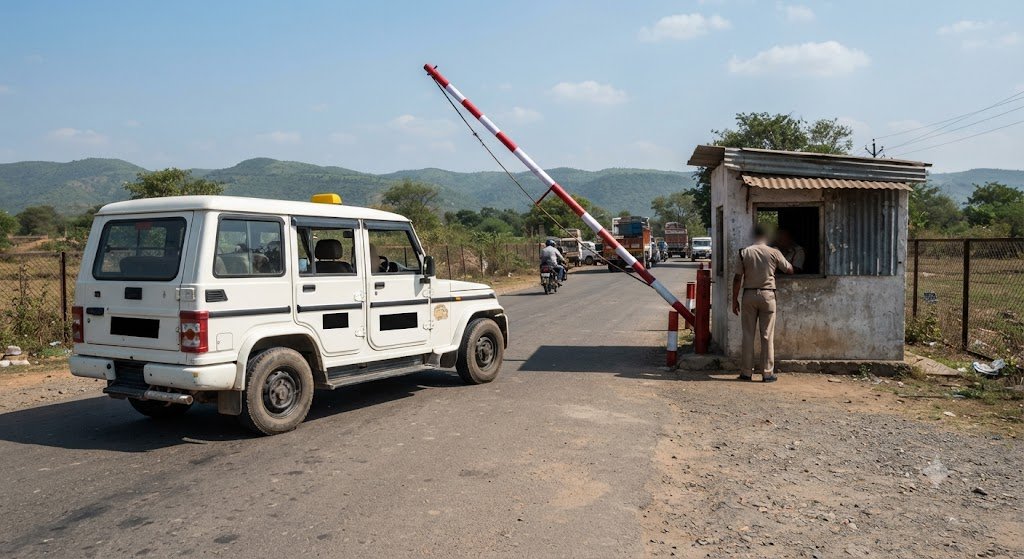
For most passengers, this entire process is invisible. The driver handles the paperwork and payment at the actual border checkpost, a brief stop of a few minutes while documents are checked and the charge is paid, the same way a toll plaza stop works. You do not need to carry any documents for this yourself, produce anything, or step out of the vehicle in the ordinary case. The only thing worth planning around is the stop itself adding a small amount of time to your journey at that specific point, worth factoring in if your schedule is tight around a flight or an event, the same way you would factor in a toll plaza queue.
How this compares to how other operators handle it
This is one of the charges where operator transparency varies the most in our experience. Some quote a suspiciously round, low headline rate and simply do not mention state border tax until it appears on the final bill, letting the customer discover it only once the trip is already underway and there is no real option to push back. Others fold an inflated, padded estimate into the base fare to avoid the conversation entirely, which usually means you are overpaying on routes that do not even cross a border. Neither approach is honest. Telling you plainly which routes cross a state line, giving a real estimate for the ones that do, and showing the actual receipt afterward is simply the more straightforward way to do this, even though it means a slightly more involved conversation upfront than just quoting one flat number.