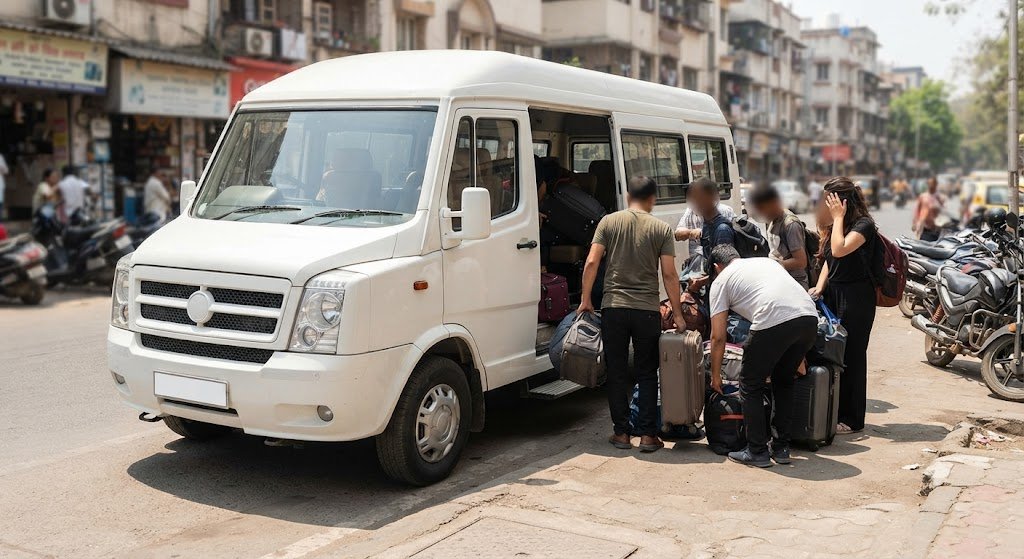
Once a group crosses ten people, the car conversation changes entirely. Nobody is comparing a sedan to an SUV anymore, the real question becomes which size of Tempo Traveller actually fits, and this is where bookings genuinely go wrong if the group size is guessed rather than counted properly. A 12 seater booked for a group that turns out to be 15 is a real problem on the day, not a minor inconvenience, people standing in a parking lot while someone works the phones trying to fix it. Here is how to get this right the first time, size by size.
The short answer
A 12 seater Tempo Traveller suits a tight group of 10 to 12 with normal luggage. A 17 seater comfortably fits 13 to 17, with room for luggage that a packed 12 seater would struggle with. A 26 seater is for genuinely large groups, 18 and above, weddings, corporate outings or extended family trips where splitting across two smaller vehicles would be more hassle than it is worth. All three run on the same per km rate, the decision is entirely about matching capacity to your actual group, not about one size costing more per kilometre than another, which genuinely simplifies the choice once you know it.
Why all three share one rate
Unlike the jump between a sedan, an SUV and an Innova Crysta, where the rate climbs with the car, every Tempo Traveller variant runs at the same starting rate regardless of seater configuration.
Variant
Seats
One way rate
Round trip rate
Local 8 hour package
12 seater
12
Rs 24 per km
Rs 22 per km
Rs 5,500
17 seater
17
Rs 24 per km
Rs 22 per km
Rs 5,500
26 seater
26
Rs 24 per km
Rs 22 per km
Rs 5,500
This means the decision genuinely comes down to picking the right size for your group, not weighing a cost difference, which makes it worth erring towards the next size up whenever you are unsure, since it does not cost more per kilometre to do so.
Why larger vehicles need a bit more planning than a sedan booking
Booking a Tempo Traveller is not meaningfully more complicated than booking a smaller car, but it does benefit from being arranged a little further ahead, particularly for a seater size and date combination that is likely to be in demand, a wedding season Saturday or a popular long weekend. Because these vehicles serve genuinely large groups, there are naturally fewer of them in the network than sedans or SUVs, which makes early booking more valuable here than it would be for a smaller car on the same date. If your date is fixed and falls anywhere near a busy period, book as early as your group’s planning allows rather than waiting until the headcount is perfectly finalised.
The 12 seater, for a tight, defined group
A 12 seater suits a group that is genuinely 10 to 12 people, not a rough estimate that might grow. This size works well for a close knit group, a small corporate team, an extended family of a defined size, or a group of friends where the headcount is firm well before the travel date. Luggage space on a 12 seater is more limited than the larger variants, comfortable for normal travel bags but tight if your group is bringing a lot beyond that.
The 17 seater, the most commonly booked size
This is genuinely our most requested Tempo Traveller size, since it fits the most common range of medium sized groups, 13 to 17 people, comfortably, with enough spare room that the vehicle does not feel packed even at close to full capacity. It also gives a usable buffer if your final headcount shifts slightly between booking and travel date, which happens more often than people expect with group trips. If your group size is genuinely uncertain and sits anywhere between 12 and 17, the 17 seater is usually the safer default.
The 26 seater, for genuinely large groups
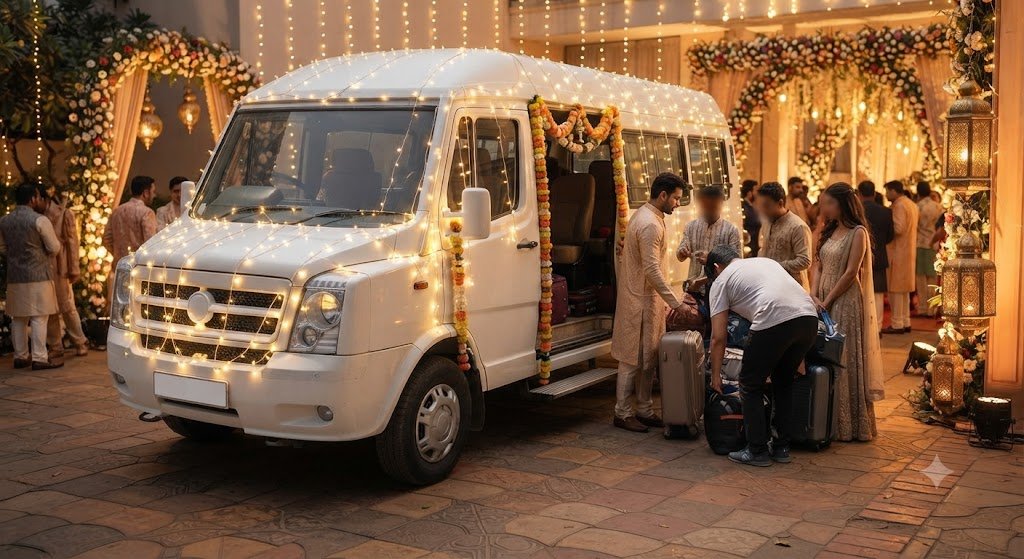
Once a group reaches 18 or more, the 26 seater becomes the practical choice, built for weddings, corporate outings, school or college group trips, and large extended family gatherings where keeping everyone together in one vehicle matters more than splitting into two smaller cars. Luggage room scales with the seating, so a full 26 seater still has reasonable room for normal group luggage, though a group bringing unusually heavy luggage per person should mention this when booking.
Comparing all three side by side
This table is the one we actually use on a booking call once someone describes their group.
Group size
Recommended variant
Why
10 to 12, firm headcount
12 seater
Right sized fit, no wasted capacity
12 to 13, headcount might grow slightly
17 seater
Buffer room if the final count shifts
13 to 17
17 seater
Our most commonly booked size, comfortable fit
17 to 18, borderline
26 seater
Avoids a packed 17 seater with no luggage room to spare
18 and above
26 seater
Built for genuinely large groups, keeps everyone together
Why guessing the headcount is the most common booking mistake
The single biggest issue we see with group bookings is a headcount given as a rough estimate rather than an actual count, “around 15” when the real number on the day turns out to be 18, or “maybe 12” that becomes 14 once everyone confirms. A Tempo Traveller cannot flex its seat count the way a decision can flex before the trip, so a vehicle booked for an estimate that turns out low leaves people standing or splitting off at the last minute, which is a genuinely bad start to a group trip. Confirm the actual headcount as close to the booking date as realistically possible, and if it is still uncertain, book the next size up rather than the exact estimated number.
What corporate and wedding bookings should think about specifically
Group size for these bookings often needs more than a headcount, corporate outings sometimes need room for equipment or display material alongside staff, and wedding bookings frequently involve multiple pickup points, picking up family from one location and friends from another before heading to the venue. Mention both the headcount and any special luggage or multi stop pickup needs when booking, since this can affect whether the 17 or 26 seater is genuinely the better fit even for a headcount that would otherwise suggest the smaller option.
Luggage room across the three sizes
Luggage capacity scales with the seater size, but it is worth being specific about what this actually means in practice rather than assuming more seats automatically means proportionally more luggage headroom at any given occupancy level.
A 12 seater at full capacity has tighter luggage room than a 17 seater running at the same 12 passengers
A 17 seater running under capacity, say 13 to 14 people, has genuinely generous luggage room
A 26 seater at a moderate 18 to 20 passengers has the most comfortable luggage to passenger ratio of the three
Any of the three running at full rated capacity should expect luggage space to be the main constraint, not seating comfort
This is exactly why booking a size with some headroom, rather than the exact minimum for your headcount, consistently gets better feedback from groups than booking tight to capacity.
Splitting into two smaller vehicles instead, when it actually makes sense
A single large Tempo Traveller is not automatically better than two smaller vehicles for every group. If your group of 20 genuinely splits into two separate sub groups with different pickup areas and different arrival needs, perhaps half the group has a flight to catch after arrival and half does not, two 12 or 17 seaters can work out more practical than one 26 seater everyone has to coordinate around. The combined cost is often similar, so this comes down to coordination and flexibility rather than price. Mention if your group has this kind of internal split when you book, since it changes the recommendation from a single large vehicle question into a genuinely different planning conversation.
What driver and route planning looks like for larger groups
A 17 or 26 seater on a multi stop pickup route, picking up from several points before heading out of the tricity, needs the pickup order planned properly to avoid a long, inefficient loop before the actual trip even starts. Give us every pickup point when you book a multi stop group trip, not just the first one, so the driver has the full route planned rather than working it out stop by stop. This matters more as group size grows, since a 26 seater with five pickup points across the tricity needs real route planning to avoid wasting an hour before the trip has properly begun.
A worked example, a wedding group with two pickup points
Take a wedding party of 16 guests, 10 picking up from Mohali and 6 from Chandigarh, heading to a venue outside the tricity, with several of the women carrying decorated outfits that need to travel flat rather than folded.
Factor
What it means for this booking
Headcount, 16
Sits right at the upper edge of the 17 seater’s comfortable range
Two pickup points
Needs the route planned in advance, not worked out on the day
Outfits needing to travel flat
Reduces effective luggage room below what the headcount alone would suggest
On headcount alone, a 17 seater looks right. Once the flat garment requirement and the two pickup stops are factored in, the honest recommendation shifts to a 26 seater, not because the group is technically too big for the smaller vehicle, but because the specific nature of the luggage and the route eats into the comfort margin a 17 seater would otherwise have. This is exactly the kind of detail worth mentioning upfront rather than letting us guess from a headcount alone.
What to check before the booking is finalised
A short list of questions, asked and answered before your date is locked in, prevents almost every group booking problem we see.
Is the headcount firm, or could it still realistically change before the travel date
Are there multiple pickup points, and if so, what order makes sense geographically
Is there any unusual luggage, decorated outfits, musical instruments, display material, beyond normal travel bags
Is the group travelling together the whole time, or does it split at some point during the trip
What time does the group actually need to arrive, working backwards from pickup times across multiple stops
Answering these honestly at the time of booking, rather than discovering the answers on the travel day itself, is what separates a group trip that runs smoothly from one that starts with confusion before it has properly begun.
How this works with Flywings
Tell us your actual headcount, as firm as you can get it, and we will recommend the right seater size rather than just confirming whatever number you first mention. See our Tempo Traveller page for the full rate table and specifications across all three variants.
If you are planning a group trip and are not sure which Tempo Traveller size fits, message us on WhatsApp with your group size and any special luggage or pickup needs and we will recommend honestly.
Frequently asked questions
Do the 12, 17 and 26 seater Tempo Travellers cost different rates per km?
No, all three run on the same starting rate, the decision is purely about matching capacity to your group size.
What if our headcount is uncertain closer to the travel date?
Book the next size up from your current estimate rather than the exact number, since there is no extra per km cost for the larger option.
Which size is most commonly booked?
The 17 seater, since it comfortably covers the most common medium group size range, 13 to 17 people, with useful buffer room.
Is luggage room the same across all three sizes at full capacity?
Luggage room scales with seater size, but all three feel tightest on luggage specifically when running at their full rated passenger capacity.
Should a wedding booking consider the 26 seater even for a smaller headcount?
Often yes, if there are multiple pickup points or extra luggage like decorated outfits, since these affect comfort more than the raw headcount alone.
Can we book multiple pickup points for a group Tempo Traveller booking?
Yes, give us every pickup point when you book so the driver has the full route planned rather than working it out stop by stop.
What happens if our actual group turns out bigger than the booked seater size?
This is exactly the scenario to avoid by confirming a firm headcount before booking, since a Tempo Traveller cannot flex its seat count on the day.
Is there a benefit to booking a bigger size than we strictly need?
Yes, since the rate is identical across sizes, booking one size up gives genuine extra luggage and seating comfort at no additional per km cost.
Why would a 16 person group need a 26 seater instead of a 17 seater?
If the group has unusual luggage, like outfits that need to travel flat, or multiple pickup points that eat into comfort margin, the extra room in a 26 seater can be worth it even above the strict headcount.
What should we check before finalising a group booking?
Confirm the firm headcount, list every pickup point, flag any unusual luggage, and clarify arrival timing, all before the date is locked in.
The one thing to remember
All three Tempo Traveller sizes cost the same per kilometre, so the only real decision is matching the vehicle to your actual, firmly confirmed headcount, with a preference for sizing up rather than booking tight to capacity. Get the headcount right and honest, and the rest of this decision is simple, there is no cost penalty for sizing up, only a real comfort benefit when the fit is generous rather than exact.